
Consortium of 10 industry-academic-research organizations launches a national R&D project to develop “6.5% Silicon-content Wide Electrical Steel Sheet” and EV efficiency-enhancing core/drive motor manufacturing technologies
Participating entities sign a multilateral MOU to collaborate across the entire value chain, from advanced material development to real-vehicle drive motor validation
POHANG, South Korea – June 11, 2026 – POSCO announced today that it has launched a major collaborative research initiative with domestic automakers, auto parts manufacturers, and research institutes to develop next-generation, high-efficiency electrical steel sheets designed to maximize the energy efficiency of electric vehicles (EVs).
The kickoff meeting for the national R&D project, titled “Development of 6.5% Silicon-content Wide Electrical Steel Sheet and EV Efficiency-Enhancing Core and Drive Motor Manufacturing Technologies,” was held on June 11 at the Research Institute of Industrial Science & Technology (RIST) in Pohang, marking the official commencement of this groundbreaking technological development.
POSCO is leading the project as the principal R&D institution. A total of ten organizations from the industry, academia, and research sectors are participating as joint R&D partners: Hyundai Motor Company, SL Corporation, Polepair Electric, RIST, the Korea Institute of Industrial Technology (KITECH), the Korea Automotive Technology Institute (KATECH), the University of Ulsan, Pukyong National University, and the Korea Metal Materials Research Association (KOMERA).
The primary objective of this national project—supported by the Ministry of Trade, Industry and Energy (MOTIE) and managed by the Korea Evaluation Institute of Industrial Technology (KEIT)—is to secure manufacturing technologies for “6.5% Silicon-content Wide Electrical Steel Sheets,” a key material for high-efficiency motors, and to validate its performance in actual EV drive motors to verify its impact on improving EV efficiency.
Electrical steel sheets are critical materials for electric motors. As the silicon (Si) content increases, the material reduces “iron loss” (power loss occurring during high-speed rotation), thereby significantly enhancing motor efficiency. However, higher silicon content makes the steel extremely brittle, making it exceptionally difficult to manufacture and process into thin, wide sheets. Standardizing the mass-production process for wide sheets of this high-silicon steel is a major technical hurdle that global steelmakers are fiercely competing to overcome.
Following the kickoff meeting, the participating organizations signed a multilateral Memorandum of Understanding (MOU). Under this agreement, the consortium will establish an integrated research and development system that spans the entire value chain: from raw material development and core fabrication to drive motor manufacturing and real-vehicle efficiency validation. This comprehensive approach ensures that the research goes beyond simple material development to verify the practical applicability of the new steel in actual EV drive motors.
“This collaboration represents a pivotal turning point where the steel and future mobility industries join forces to usher in the era of electrification,” said CHO Myung jong, Head of Future Steel R&D Center at POSCO. “We will concentrate our capabilities on developing high-value-added, advanced materials and component technologies that enhance energy efficiency, while maximizing the synergy among industry, academia, and research institutes.”
Through this project, POSCO aims to strengthen the competitiveness of the domestic steel and automotive value chains, securing a leading position in the rapidly growing global EV market.
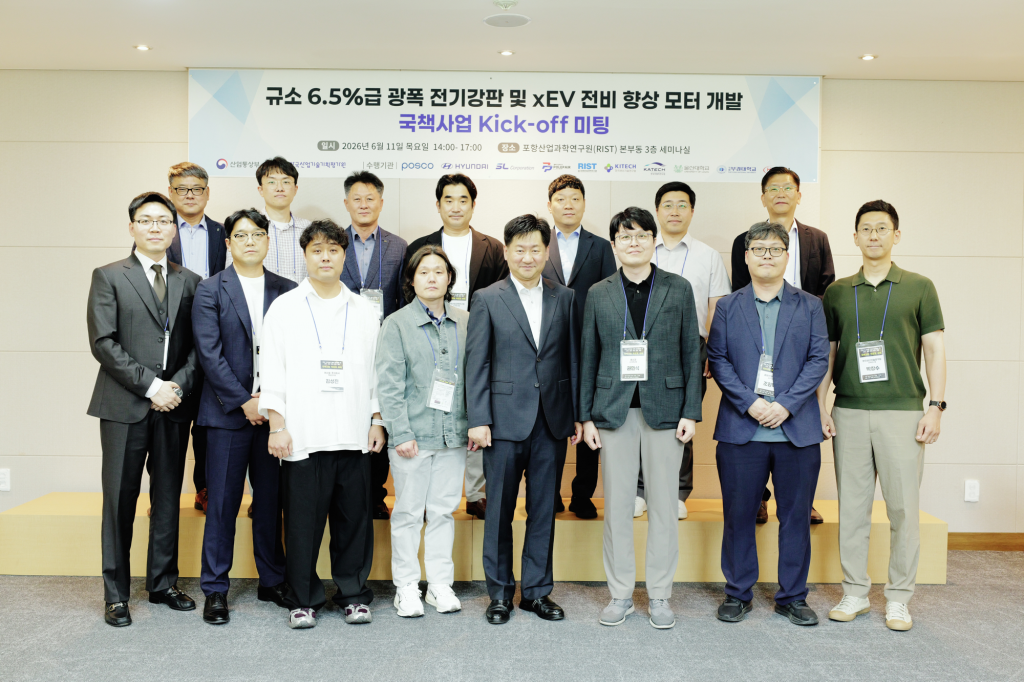
▲ POSCO, alon