
KRW 600 billion invested in Gwangyang EAF with an annual capacity of 2.5 million tons… Reducing carbon emissions by approximately 75% compared to blast furnaces
Developing “Haptang” (hot metal mixing) technology to secure blast furnace-level quality, aiming to produce premium steel such as automotive steel sheets
Steadfastly executing the 2050 Decarbonization Roadmap… Establishing a business structure anchored in a decarbonized production system
POSCO (Representative Director and President Lee Hee-geun) has completed the construction of a large-scale Electric Arc Furnace (EAF) with an annual capacity of 2.5 million tons in Gwangyang, South Jeolla Province, officially embarking on the production of low-carbon steel.
The completion ceremony, held at Gwangyang Works on the 17th, was attended by Prime Minister Kim Min-seok, National Assembly members Kwon Hyang-yeop and Jo Gye-won, South Jeolla Provincial Council Chairman Kim Tae-gyun, Gwangyang Mayor Jeong In-hwa, and Gwangyang Mayor-elect Park Seong-hyeon. Key POSCO executives and representatives also attended, including Chang In-hwa, CEO of POSCO Holdings; Lee Hee-geun, President of POSCO; and Kim Seong-ho, Head of the POSCO Labor Union.
POSCO commenced construction of the new EAF in February 2024 to align with domestic and international decarbonization policies and proactively respond to customers’ growing demand for low-carbon steel products. The newly completed EAF is the largest single facility of its kind in South Korea, built with a cumulative workforce of 270,000 personnel and an investment of approximately KRW 600 billion.
While the traditional blast furnace-converter method—which inputs iron ore and coal (coke) into a blast furnace to produce molten iron and refines it in a converter—enables the mass production of high-quality steel, it is highly carbon-intensive. In contrast, an EAF recycles steel scrap, reducing carbon emissions by up to approximately 75%* compared to blast furnaces.
* Note: Compared to the average of 2017–2019, POSCO’s baseline years for calculating carbon reduction. This rate may vary depending on scrap supply conditions and power generation sources (based on crude steel, Scope 1 & 2).
POSCO is also focusing on developing “Haptang” (hot metal mixing) technology to enhance the quality of EAF-produced steel. This technology refines a mixture of molten iron produced from both the EAF and the blast furnace, enabling the production of premium steel while significantly reducing carbon dioxide emissions compared to conventional blast furnace operations. By securing additional core technologies—such as the selection and classification of scrap (the primary raw material) and precise composition control during the refining process—POSCO aims to mass-produce automotive steel sheets and electrical steel sheets by 2030.
To this end, POSCO has designated EAF-produced premium steel as one of its “Eight Strategic Products” and has accelerated the development of specialized products by forming an integrated project team spanning R&D, production, and sales. In addition, the company plans to concurrently develop “bridge technologies” that contribute to carbon reduction within the existing production system, such as hydrogen-rich gas injection into blast furnaces, top-and-bottom blowing converters, and carbon-reduced raw material technologies.
Recently, domestic carbon reduction requirements have intensified with the strengthening of Nationally Determined Contributions (NDCs) and the implementation of the Phase 4 Emissions Trading Scheme (ETS), alongside the full-scale rollout of the EU’s Carbon Border Adjustment Mechanism (CBAM). POSCO aims to transition to a decarbonized production system through its proprietary hydrogen reduction steelmaking technology, “HyREX.” Until HyREX is commercialized, the newly built EAF will play a pivotal role in driving greenhouse gas reductions and strengthening the company’s low-carbon product portfolio.
During the ceremony, Chang In-hwa, CEO of POSCO Holdings, emphasized, “The EAF completed today is not merely the addition of another facility; it is a powerful declaration of our commitment to resolving the defining challenge of our era—decarbonization—and reshaping the global market.” He added, “POSCO will proactively respond to the low-carbon steel demands of our global customers and further solidify our position as a leading provider of future materials.”
Prime Minister Kim Min-seok remarked, “The completion of the EAF at Gwangyang Works is a landmark event symbolizing the future of the steel industry as it evolves into an eco-friendly sector.” He promised, “The government will support the quality improvement and supply stabilization of steel scrap, and ensure the seamless execution of the hydrogen reduction steelmaking demonstration project.” He further emphasized, “The government will exert policy efforts to ensure that the hard work and dedication of the steel industry, which has served as a reliable pillar of our economy despite challenging domestic and international conditions, bear valuable fruit.”
POSCO is also accelerating the groundwork for the commercialization of HyREX. Following the Ministry of Land, Infrastructure and Transport’s approval of the Pohang National Industrial Complex plan revision last March, the reclamation of approximately 1.35 million square meters (410,000 pyeong) of public waters near Pohang Works has gained momentum. POSCO plans to complete the development of commercialization technology by 2030 using a 300,000-ton annual capacity HyREX demonstration facility, and progressively transition to a decarbonized production system.
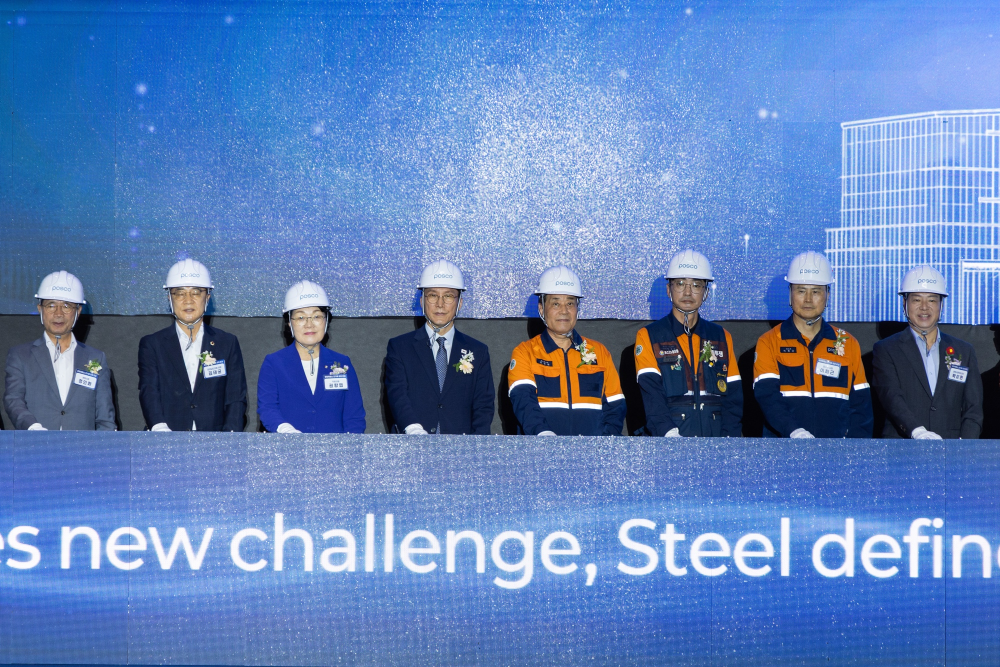
▲ On the 17th, POSCO completed the construction of the EAF plant at Gwangyang Works. (From left) Gwangyang Mayor Jeong In-hwa; South Jeolla Provincial Council Chairman Kim Tae-gyun; National Assembly Member Kwon Hyang-yeop; Prime Minister Kim Min-seok; Chang In-hwa, CEO of POSCO Holdings; Kim Seong-ho, Head of the POSCO Labor Union; Lee Hee-geun, President of POSCO; and Gwangyang Mayor-elect Park Seong-hyeon.

▲ Prime Minister Kim Min-seok (left) and Chang In-hwa, CEO of POSCO Holdings, greet each other at the completion ceremony of the EAF plant at Gwangyang Works on the 17th.
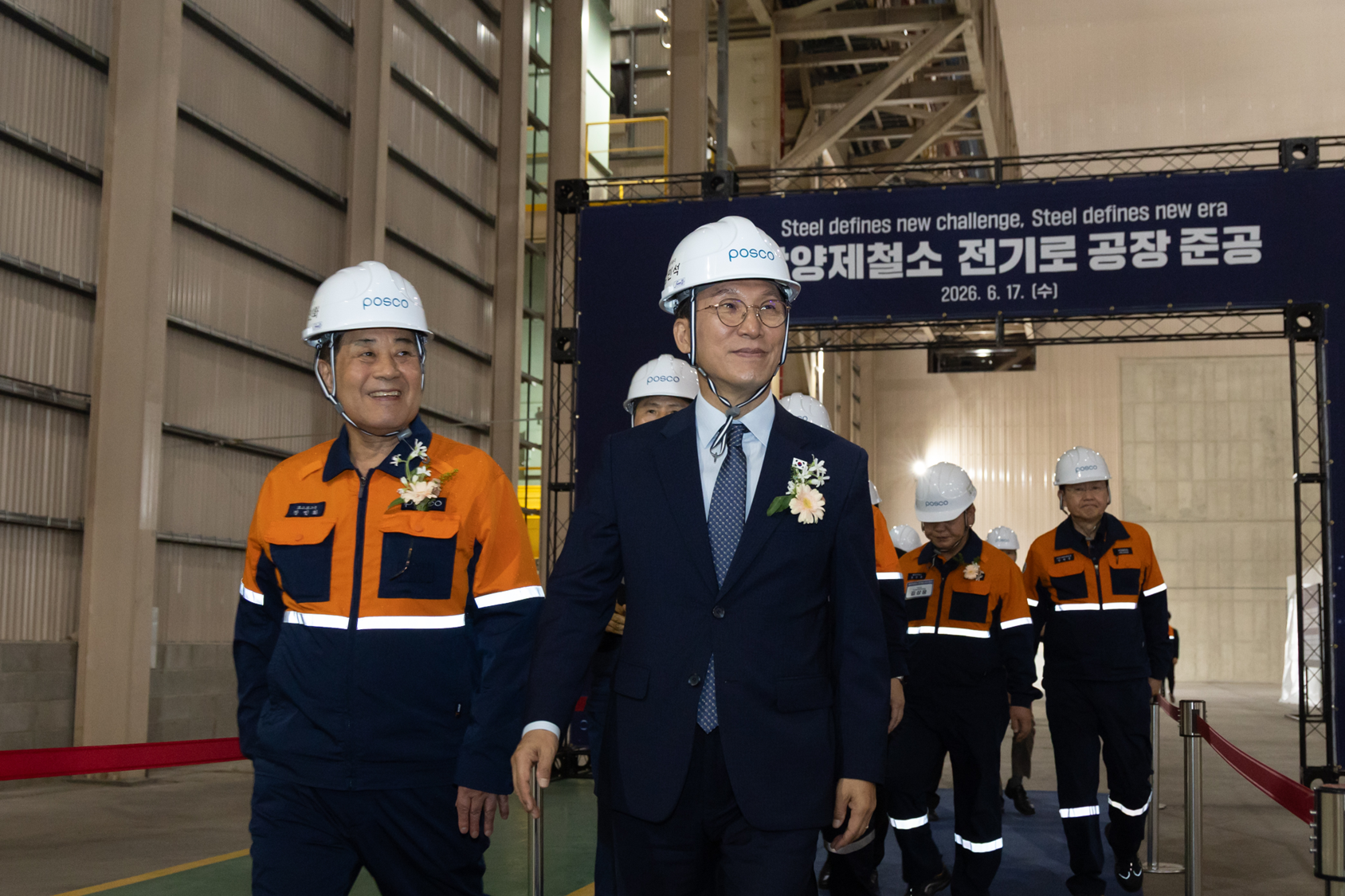
▲ Prime Minister Kim Min-seok (right) and Chang In-hwa, CEO of POSCO Holdings, enter the completion ceremony of the EAF plant at Gwangyang Works on the 17th.