
Addresses demand in high-value markets such as premium EVs with energy storage capacity more than four times that of graphite-based anode materials and faster charging speeds
Silicon nano-sizing technology and carbon composite technology substantially reduce volume expansion… overcoming the biggest barrier to commercialization
Targeting mass production and supply in 2028, taking into account market demand and evolving market conditions
POSCO Future M has secured mass-production technology for silicon anode materials and completed preparations to capture the next-generation battery market.
Silicon anode materials offer significantly higher energy density and faster charging rates than conventional graphite-based anode materials, and market demand is expected to expand rapidly, driven by high-performance, high-power batteries for applications such as electric vehicles (EVs) and robotics.
The silicon anode material developed by POSCO Future M can store more than four times the energy of graphite-based anode materials. Silicon anode materials are typically blended with graphite-based anode materials for use in batteries; in testing with a blending ratio of 20% or more, POSCO Future M’s material retained over 80% of its initial capacity after 1,000 charge/discharge cycles. This result notably surpasses the single-digit blending ratios of conventional batteries, demonstrating that the company has achieved not only high capacity but also long-term performance retention.
Volume expansion during charge/discharge cycles has long been identified as the primary challenge to the commercialization of silicon anode materials, despite their high energy storage capacity. The Technology Research Laboratory of POSCO Future M has addressed this challenge by applying proprietary silicon nano-sizing and carbon composite technologies to substantially reduce expansion, thereby securing a commercially viable solution.
“Silicon anode materials are a next-generation core material that will determine battery performance,” said HONG Young Jun Head of the Technology Research Laboratory. “Building on our accumulated materials expertise and mass-production experience, we will deliver the best solutions to our customers while continuing to expand our competitive edge in the global market.”
POSCO Future M has secured silicon anode mass-production technology through product testing and quality verification with key domestic and international customers, and is targeting mass production and supply in 2028, taking a comprehensive view of overall market demand and evolving market conditions.
Demand is expected to gain momentum, particularly in the premium EV segment, in which extended driving range and reduced charging time are simultaneously required, with high potential for expansion into next-generation markets such as humanoid robots and urban air mobility (UAM). POSCO Future M continues to refine its technical capabilities through collaboration with Factorial, a US-based solid-state battery specialist, across both the cathode and silicon-anode material segments.
From now on, POSCO Future M plans to enhance competitiveness through advances in process technology and productivity improvements, and to build a stable supply infrastructure to meet the rapidly growing demand for silicon anode materials.
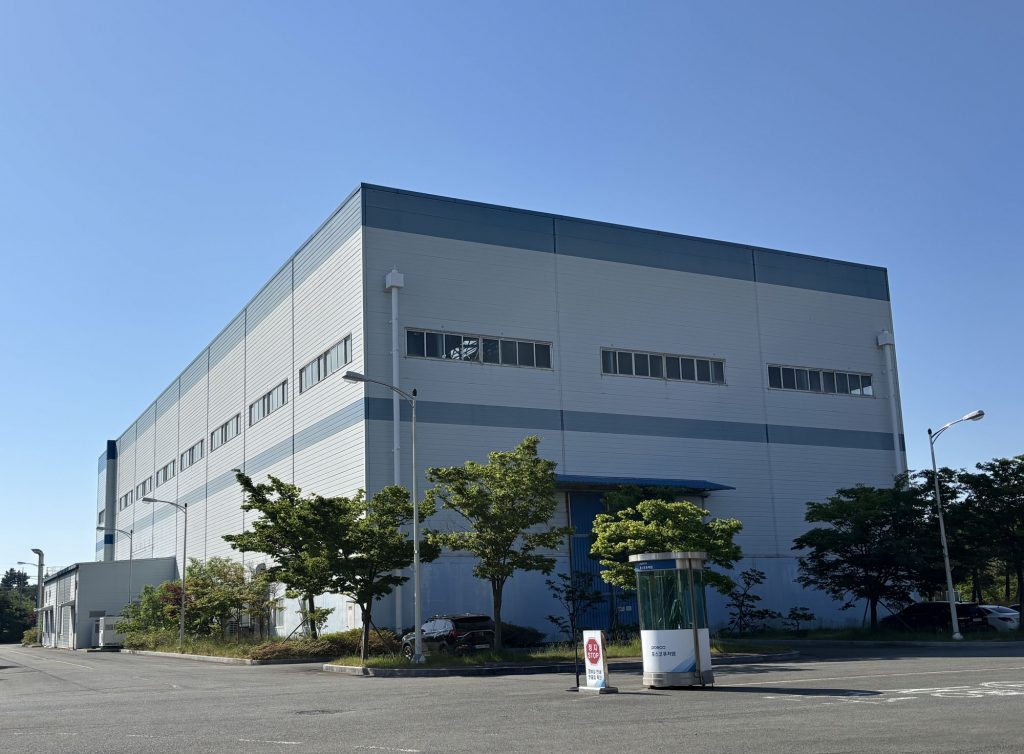
▲ POSCO Future M has secured mass-production technology for silicon anode materials — widely regarded as a next-generation core battery material — and completed preparations to capture the next-generation battery market. Pictured is the exterior of POSCO Future M’s silicon anode material demonstration plant, located in Pohang.