
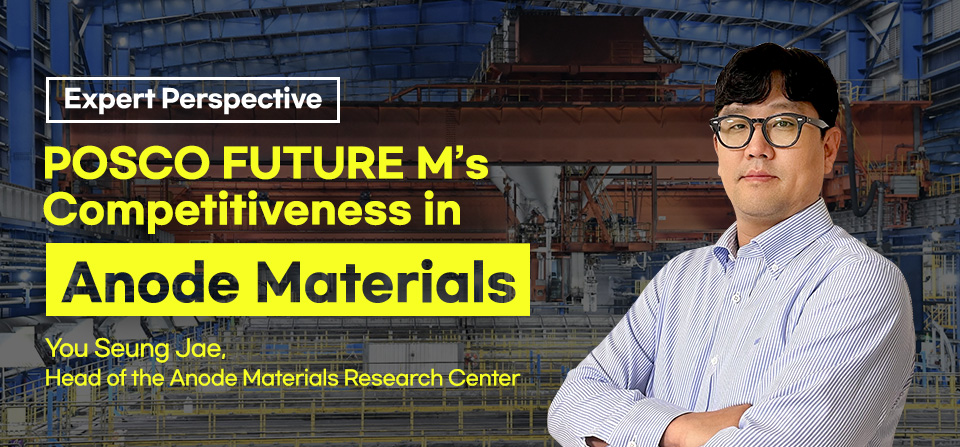
In today’s global battery industry, success hinges on one critical factor: securing a stable and resilient supply chain that can withstand regulatory risks. As regulations in the United States and Europe emerge as major challenges for the industry, POSCO FUTURE M is turning those challenges into opportunities through its differentiated supply chain strategy. Following contracts worth KRW 670 billion to supply natural graphite anode materials to a global automaker, the company further demonstrated its competitiveness by signing a KRW 1 trillion long-term supply agreement for artificial graphite anode materials in March this year. These achievements are the result of years of effort to internalize the full value chain from raw materials and intermediates to finished products. We spoke with Yoo Seung-Jae, Head of the Anode Materials Research Center, about POSCO FUTURE M’s vision for an independent anode materials supply chain and the progress of its technology development.
PART 01
From Natural to Artificial Graphite: POSCO FUTURE M Advances Localization of Anode Materials
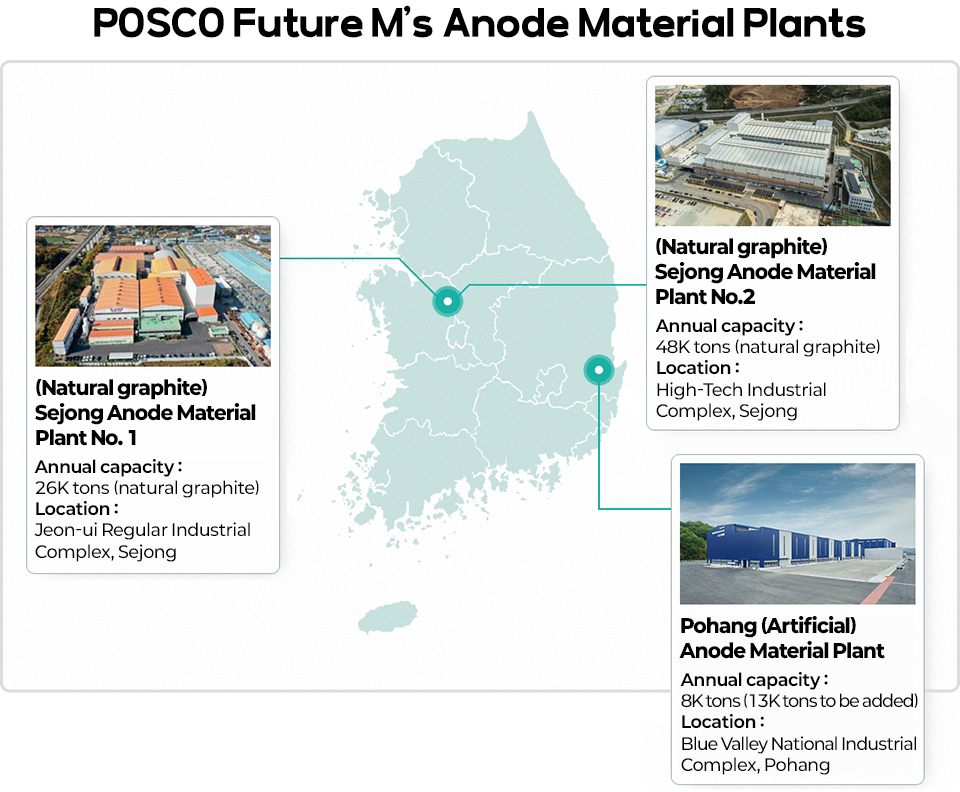
POSCO FUTURE M’s greatest strength lies in its differentiated portfolio, which enables the company to mass-produce and supply both natural graphite and artificial graphite anode materials in line with the rapidly evolving needs of the global battery market.
The anode of an EV battery is made by blending natural graphite and artificial graphite, and demand for artificial graphite anode materials has recently increased in response to the market shift toward higher performance and faster charging. Natural graphite anode materials, made from flake graphite mined from natural deposits, offer excellent energy storage capacity and cost competitiveness. Artificial graphite anode materials, produced through high-temperature heat treatment, provide superior structural stability, making them better suited for maximizing fast-charging performance.
By mass-producing both materials, POSCO FUTURE M can respond flexibly to changing market demand. In addition, the company is accelerating the commercialization of silicon anode materials for next-generation all-solid-state batteries and other advanced applications, further strengthening one of the industry’s most comprehensive portfolios. The company continues to demonstrate its global technological competitiveness, particularly by maximizing productivity through continuous process innovation.
These achievements are the result of long-term efforts to localize production. After successfully localizing natural graphite anode materials in 2011, POSCO FUTURE M completed its artificial graphite anode materials plant in Pohang in 2021, establishing an independent mass-production system. This localization and internalization of raw materials go beyond technological self-reliance and have become a distinct competitive advantage, enabling the company to offer customers one of the most stable supply chains in a global market increasingly exposed to geopolitical risks.
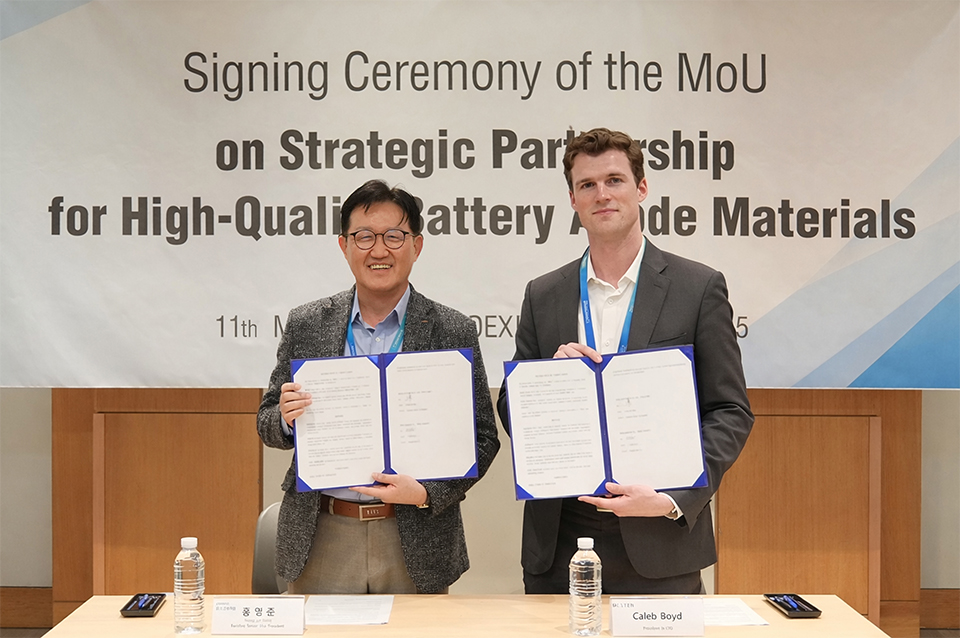
▲ In March, POSCO FUTURE M signed an MOU with Molten to jointly develop raw materials for natural graphite anode materials using methane gas.
POSCO FUTURE M is working with U.S.-based Molten* to develop natural graphite anode materials using raw materials that do not rely on mining. This initiative is meaningful because it moves beyond the conventional dependence on mined graphite and introduces a new approach to securing key raw materials by combining the two companies’ differentiated capabilities in raw materials and materials technology. Through this collaboration, the company expects to diversify its raw material supply chain, reduce costs, and strengthen its differentiated competitiveness in the global market.
* Molten: A California-based company with the world’s only technology capable of producing graphite through methane pyrolysis.
POSCO FUTURE M plans to reinforce its raw materials supply chain by combining Molten’s methane-based graphite production technology with its own anode materials manufacturing technology. Once Molten produces graphite through methane pyrolysis, POSCO FUTURE M’s subsidiary Future Graph will process it into spherical graphite, after which the Sejong plant will produce the final natural graphite anode materials.
Graphite produced from methane gas contains fewer metallic impurities than mined graphite, making it possible to significantly simplify the refining process. This could lead to substantial cost reductions in anode materials production. In addition, hydrogen generated as a byproduct during methane pyrolysis could be used for power generation or supplied to POSCO’s hydrogen reduction ironmaking process, creating synergies across POSCO Group.
________________________________________
PART 02
Building an Independent “K-Anode Materials” Supply Chain Through POSCO Group Synergies
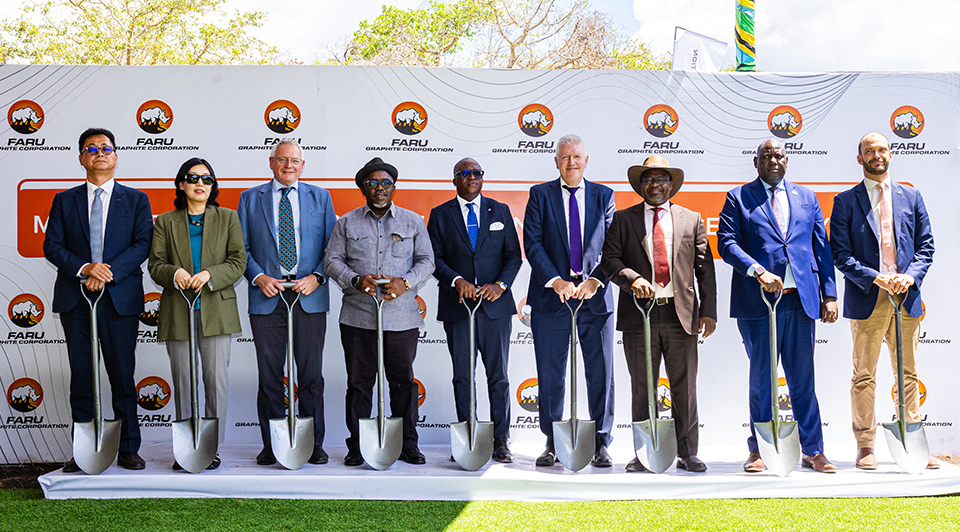
▲ Last year, POSCO International began developing the Mahenge graphite mine in Tanzania, the world’s second-largest graphite deposit by reserves.
Graphite is a key raw material for battery anode materials, but more than 90% of global supply is concentrated in one country, creating significant supply chain risk. As demand surges with the growth of the EV and ESS (Energy Storage System) markets, securing alternative supply sources has become essential. In response, POSCO Group has built a vertically integrated structure for its battery materials business by linking POSCO International’s raw material sourcing capabilities with POSCO FUTURE M’s materials production. Going forward, the Group plans to directly use graphite secured from Africa in anode materials production, thereby increasing raw material self-sufficiency and easing supply chain instability.
The greatest strength of POSCO Group’s battery materials business lies in its structure, which combines the Group’s raw material sourcing capabilities, cathode and anode materials technologies, and manufacturing process expertise. This enables the Group to provide global battery customers with both supply stability and competitiveness.
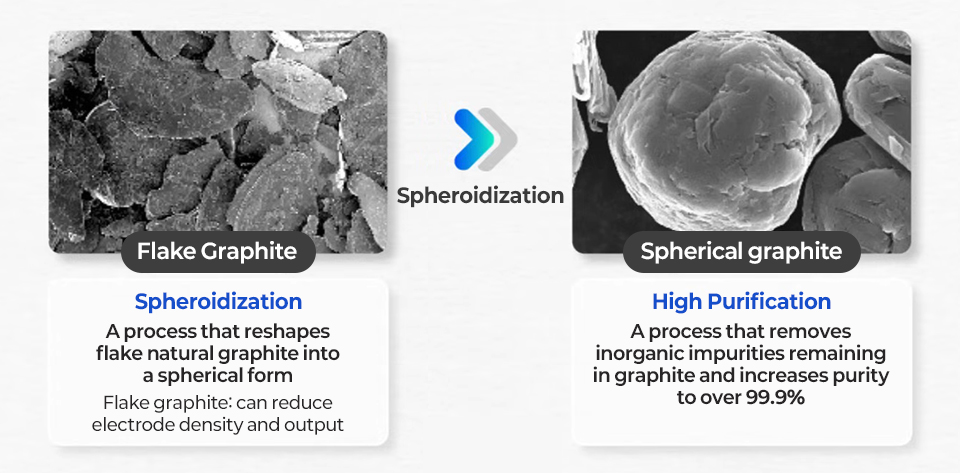
▲ POSCO FUTURE M is focusing on internalizing spheroidization and purification technologies for natural graphite anode materials. Source: POSCO FUTURE M
In particular, for natural graphite anode materials, dependence on a specific country is extremely high in the case of spherical graphite, an intermediate material produced by shaping mined graphite into round particles and increasing its purity. To respond to global supply chain regulations such as the U.S. Inflation Reduction Act (IRA), achieving technological self-reliance at this stage is essential.
To address this, POSCO FUTURE M is building a system in which graphite ore secured by POSCO Group in Africa and other regions is processed into spherical graphite at the Saemangeum plant of its subsidiary Future Graph and then sent to the Sejong plant, where it is turned into final natural graphite anode materials. Based on this localized supply chain, the company plans to supply products stably to global battery makers and automakers.
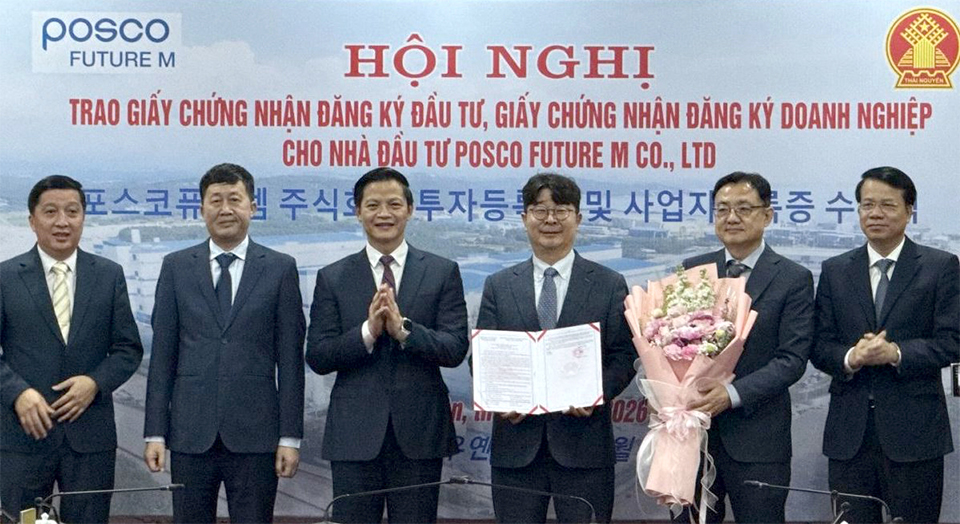
▲ In April, POSCO FUTURE M and Thai Nguyen Province held a preliminary event for the delivery of the Investment Registration Certificate (IRC) for the artificial graphite anode materials project in Vietnam.
Artificial graphite anode materials are essential for enabling fast charging and improving battery life, but dependence on a specific country remains high, making supply chain diversification an urgent priority. Vietnam offers outstanding cost competitiveness compared with other Southeast Asian countries thanks to lower investment costs, electricity rates, labor costs, and logistics expenses. It also has a stable power grid, strong industrial infrastructure, and favorable trade relations with key countries including the United States.
POSCO FUTURE M is investing approximately KRW 357 billion to build an artificial graphite anode materials plant in Thai Nguyen, an industrial city in northern Vietnam. Construction is scheduled to begin in the second half of this year, with mass production targeted for 2028. Depending on future orders, the site can be expanded in phases to reach a maximum annual capacity of 55,000 tons.
PART 03
From EVs to Emerging Industries: Next-Generation Silicon Anode Materials Technology
Silicon anode materials offer high capacity, making them well suited to extending EV driving range and shortening charging time. However, because silicon undergoes significant volume expansion during charging and discharging, it has traditionally been used in blends with graphite anode materials.
POSCO FUTURE M has successfully developed silicon anode materials with about five times the capacity of graphite-based anode materials while minimizing expansion through proprietary coating technology. Since May 2024, the company has been operating a demo plant to produce these materials and is currently in discussions with global customers regarding commercialization and the establishment of a mass-production system.
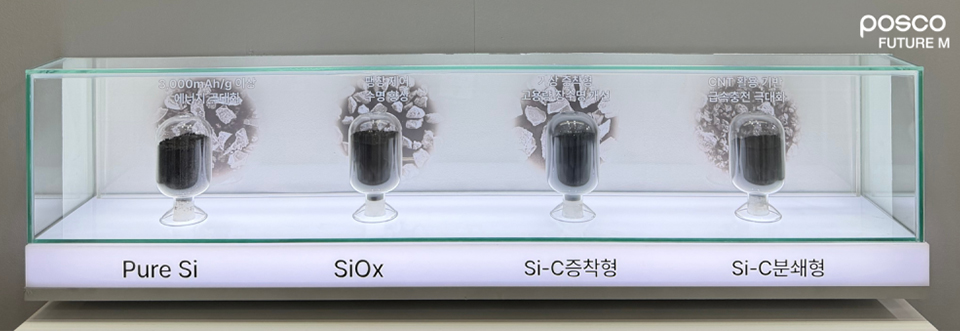
▲ A sample of POSCO Group’s silicon anode materials displayed at INTERBATTERY 2026.
Emerging industries such as humanoid robots, drones, and aerospace require batteries that minimize weight and volume while delivering high energy density and fast charging. Demand for silicon anode materials is expected to grow rapidly not only in robots and drones, where long operating time and fast charging are essential, but also in aerospace, where high output and reliability are critical. POSCO FUTURE M’s silicon anode materials offer greater capacity and better charging performance than conventional graphite-based materials, making them an ideal solution for applications with strict space and weight constraints.
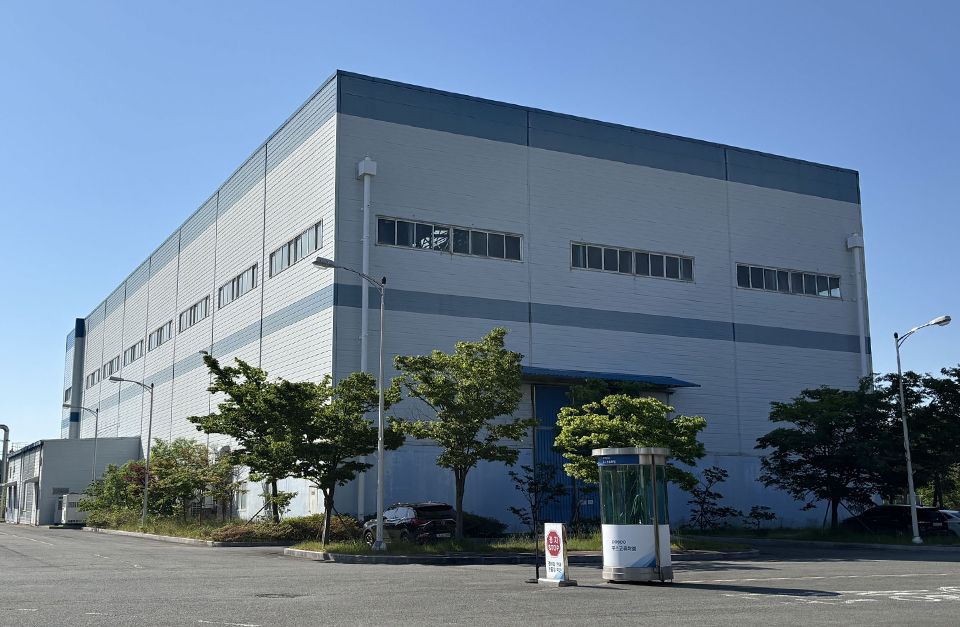
▲ POSCO FUTURE M’s silicon anode materials demo plant in Pohang.
As Korea’s only producer of graphite-based anode materials, POSCO FUTURE M has successfully localized both natural graphite and artificial graphite anode materials and is now expanding its portfolio into next-generation materials such as silicon anode materials.
Based on 15 years of research, the company has developed a range of products applying proprietary technologies. Among them, its low-expansion natural graphite anode material improves material structure through a high-density spheroidization process, enhancing fast-charging performance while lowering the expansion rate and maintaining strong price competitiveness. Its uncoated low-temperature-calcined natural graphite anode material, meanwhile, helps suppress silicon expansion when blended with silicon anode materials, and demand for this product is expected to rise in line with the growth of the silicon anode materials market.
Building on these proprietary products and the competitiveness of its vertically integrated structure spanning raw materials, materials, and products, POSCO FUTURE M will continue to proactively respond to future battery requirements such as fast charging, high output, and high energy density. Through these efforts, the company aims to grow into a global top-tier anode materials solutions provider serving not only EVs but also emerging industries including robotics, drones, and aerospace.