The hydrogen industry, once hailed as a potential savior for a carbon-free energy future, is now facing a period of stagnation after running into barriers such as weak economic viability, infrastructure gaps, and policy uncertainty. Looking back, however, the LNG industry—now a pillar of the global energy market—also began more than 50 years ago amid intense debate over its commercial viability and serious safety concerns. By retracing LNG’s journey of overcoming adversity and ultimately reshaping the global energy landscape, we can identify strategic lessons to help today’s hydrogen industry break through its current “chasm.”
Senior Research Fellow Park Yong-sam POSCO Research Institute
LNG’s Risk-Sharing Strategy for Overcoming Asset Specificity
The LNG business requires massive capital investment across the entire value chain: extracting gas upstream, liquefying and transporting it by ship midstream, and regasifying and supplying it downstream. In addition, LNG assets have a high degree of asset specificity*, creating structural risks: sellers worry about being unable to sell their gas, while buyers fear supply disruptions. To launch such large-scale projects, both sides need a strong financial safety net. LNG has therefore grown by distributing risk through take-or-pay contracts and sophisticated financial and contractual structures.
*Asset specificity: The characteristic of an asset designed for use in a specific transaction or purpose, resulting in significant loss of value if it is converted to another use
“Pay Even If You Don’t Take the Gas”: Sharing Risk Through Take-or-Pay Contracts
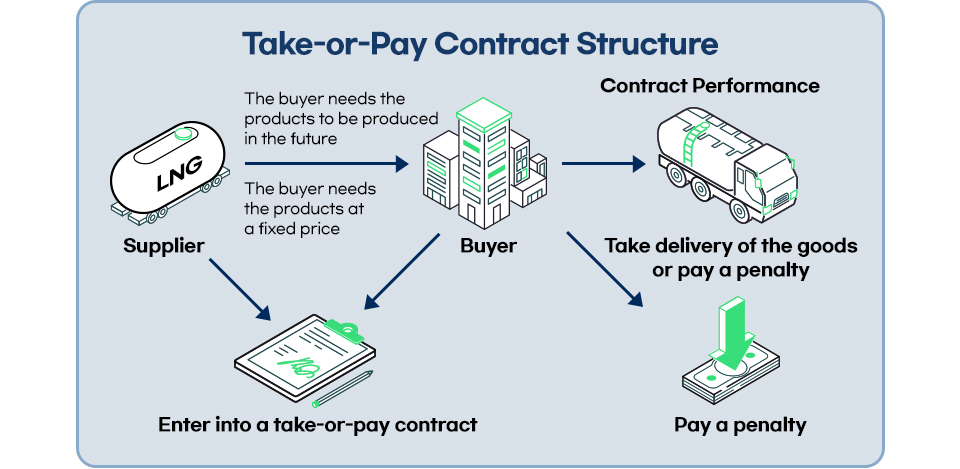
Introduced in the late 1960s, take-or-pay provisions became the backbone of the LNG business. Under these provisions, buyers are required to pay for a predetermined minimum volume each year, regardless of whether they actually take delivery of the gas. This enabled sellers to secure stable annual cash flow. Banks used these long-term contracts as collateral to provide project financing*, allowing LNG projects to lower their borrowing costs by more than 170 basis points and achieve economic viability. In addition, long-term contracts lasting 20 to 25 years tied suppliers and buyers together in close partnerships, serving as a strong safeguard against market volatility.
*Project financing: A financing method that raises funds based on a project’s future cash flows and its own assets, rather than the creditworthiness or collateral of the sponsoring company
■ Neither Too High nor Too Low: Oil Indexing and the S-Curve
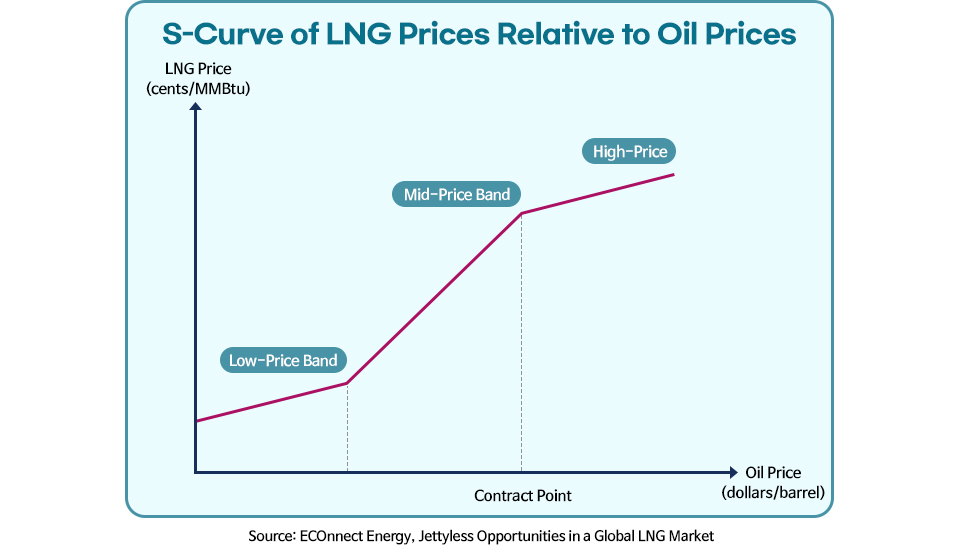
Because there was no established gas market in the early days of LNG, gas prices were linked to those of competing fuels, particularly oil. The benchmark used was the JCC (Japan Customs-cleared Crude Price)*, which represents the average price of crude oil imported into Japan. If oil prices rose or fell too sharply, one party to the contract could face bankruptcy. To prevent this, the industry introduced an S-curve formula that moderated fluctuations in gas prices and created a safeguard for mutual benefit.
*JCC (Japan Customs-cleared Crude Price): A representative benchmark used to link the prices of long-term LNG contracts in East Asia to oil prices
■ Evolving from Rigid Rules to Flexible Trading
In its early days, the LNG market operated under a highly restrictive point-to-point model, earning it the nickname “floating pipeline.” Gas could not be sold anywhere other than the designated destination. However, as the number of market participants grew and infrastructure expanded after the 1990s, short-term contracts of two to three years and spot-market trading became increasingly active. As a result, when major crises struck—including the 2011 Fukushima nuclear accident and the 2022 Russia-Ukraine war—countries around the world were able to exchange gas flexibly and overcome the resulting challenges.
The Weapon Beyond Technology and Capital: Social Acceptance
The final hurdle to commercializing LNG was not technology or financing, but public perception—in other words, social acceptance. The key to LNG’s success was transforming the question, “Why should we use LNG when it is expensive and dangerous?” into a broader national aspiration.
■ Breaking Through the Early Dilemma with Oil Shocks and Environmental Regulations
In its early days, LNG was over 30% more expensive than coal or oil. Moreover, methane (CH₄), its main component, has a global warming potential 25 to 30 times greater than that of carbon dioxide. This led to criticism that LNG was only “partially clean”—that leaks during production or transportation could cause even greater environmental damage. Since the market was already accustomed to coal and oil, private companies had little reason to choose LNG voluntarily.

▲ Long lines of cars at a gas station in Maryland, U.S., following the oil shock on June 15, 1979 (Photo source: Wikimedia Commons)
The 1973 oil shock and environmental regulations changed this trajectory. As oil prices soared, governments around the world began encouraging LNG adoption through subsidies and tax incentives as part of their efforts to strengthen energy security. In addition, as the International Maritime Organization (IMO) tightened regulations on sulfur oxide emissions from ships, LNG began attracting attention not only as a fuel for power generation but also as a marine fuel. Building on this momentum, the LNG industry successfully positioned LNG as “a bridge from coal to renewable energy” and secured policy support from governments.
■ Securing Social Acceptance Through Government Guarantees and Environmental Campaigns
Strong government guarantees also played a critical role. The governments of the United Kingdom and France regarded LNG not simply as a fuel, but as a strategic asset that could contribute to national energy security. By directly guaranteeing long-term purchases, they created an environment in which banks could lend with confidence. When the Brunei LNG project was launched in 1969, Mitsubishi Corporation of Japan was able to invest several times its capital contribution largely because of the extensive support and guarantees provided by government-backed financial institutions, including the Export-Import Bank of Japan (JEXIM) and trade insurance provided by Japan’s Ministry of International Trade and Industry.
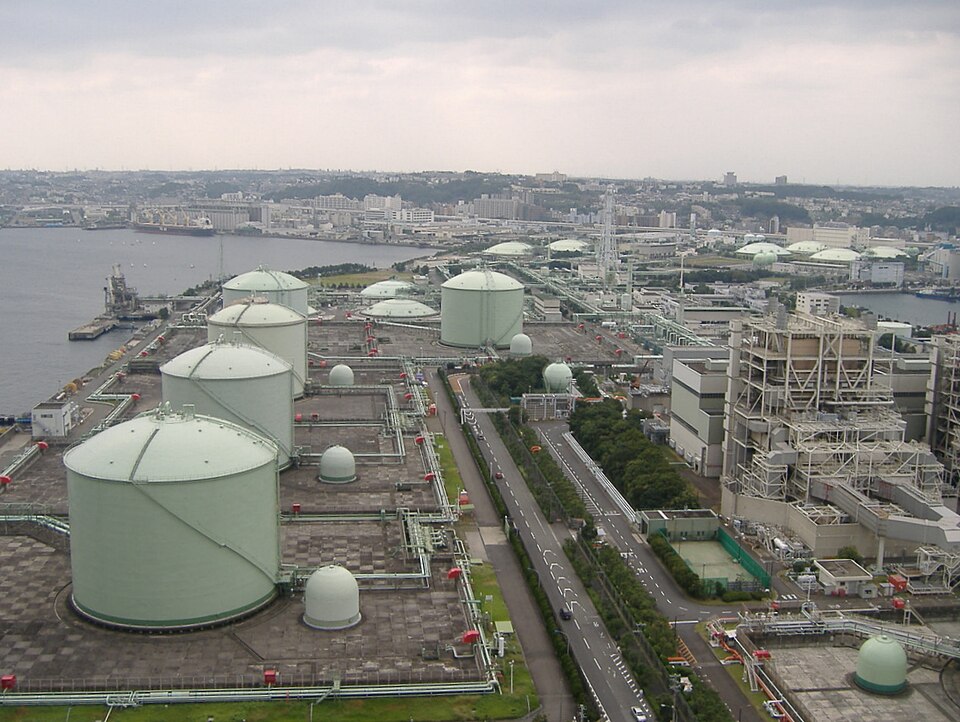
▲ Tokyo Gas’s Negishi LNG Terminal in Yokohama, Japan (Photo source: Wikimedia Commons)
Tokyo Gas’s “Clean Air” campaign in 1969 also played a significant role. Through the campaign, Tokyo Gas presented LNG to residents suffering from severe air pollution and smog not simply as “a new fuel,” but as the solution to restoring Tokyo’s blue skies. By working with the city government to promote LNG as a public-private initiative to combat pollution, Tokyo Gas helped residents overcome their vague concerns and embrace LNG with confidence.
■ Hydrogen Needs a New Identity
Like LNG before it, the hydrogen industry today must establish an identity that gives it social legitimacy. Hydrogen should be presented not simply as a new fuel, but as a strategic asset for responding to Europe’s Carbon Border Adjustment Mechanism (CBAM) and a means of contributing to the transition to a low-carbon economy.
A phased strategy is also needed: first, gradually securing economic viability through blue hydrogen—produced by reforming natural gas supplied as LNG, with carbon capture, utilization and storage (CCUS)—using existing facilities, and then exploring the long-term transition to renewable energy-based hydrogen. Just as LNG helped resource-poor countries such as Korea and Japan strengthen their energy self-sufficiency in the past, expanding the hydrogen supply chain can contribute to national energy security. This value must be communicated widely.
LNG was once considered “madness” from an engineering perspective, a “reckless challenge” economically, and a “dangerous provocation” socially. Yet it overcame technological barriers through materials innovation, eased financing constraints through long-term contracts, and overcame operational limitations through standardization.
Viewed against LNG’s 70-year journey, the temporary stagnation facing the hydrogen industry today is not a retreat, but a preparation phase for a full-scale breakthrough. If the industry identifies bottlenecks across the hydrogen value chain, develops the necessary technologies, and builds a robust global partnership network, it can become a market leader when the hydrogen market fully takes off.