
Against the formidable current of global supply chain restructuring, POSCO group is fortifying its business competitiveness by identifying new growth engines in overseas markets. In this first episode of “POSCO Goes Global,” we explore POSCO group’s global expansion strategy in Australia, a country with whom we have maintained a partnership for over half a century.
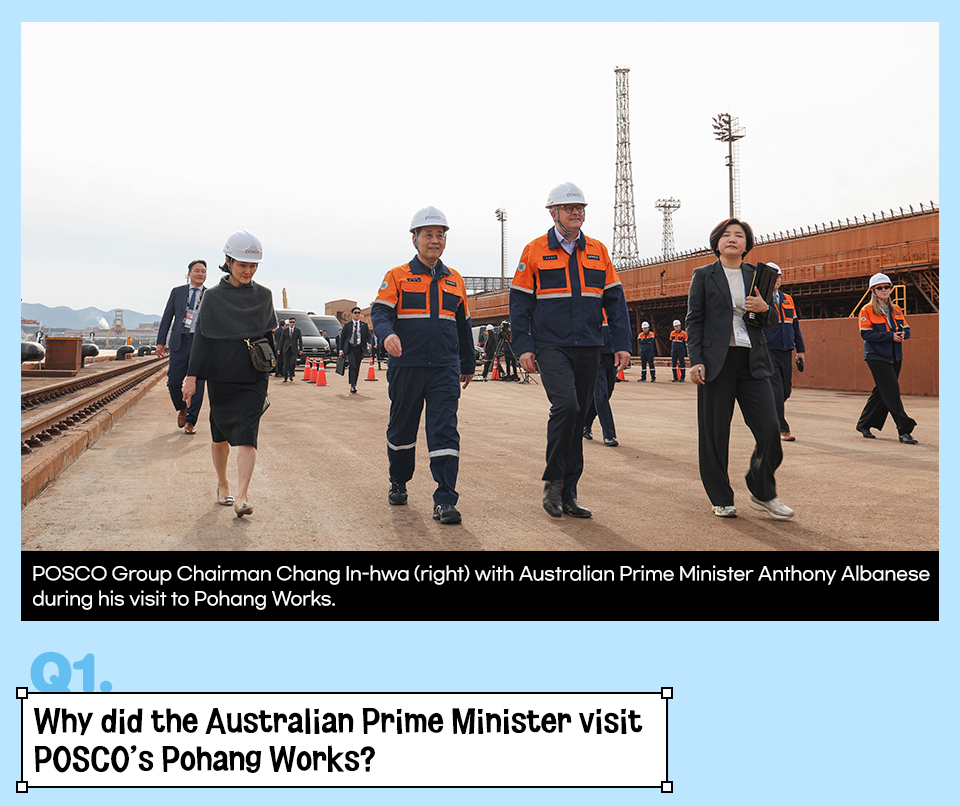
During the 2025 APEC Summit hosted in Gyeongju, The Hon. Anthony Albanese, Prime Minister (PM) of Australia, made a visit to Pohang Works. This marked the first visit by an Australian PM in 22 years, since the visit by The Hon. John Howard in 2003.
Prime Minister Albanese took the opportunity to stress the importance of continued cooperation. “Australia and POSCO have had a trust-based cooperation for over half a century, and we will continue to strengthen our partnership through dependable supply of raw materials and low-carbon technology development.”
The visit delivered an important message that promised to elevate the bilateral partnership between Korea and Australia across key sectors, including mining resources, industrial materials, and future energy.
Yes, it has been 55 years. Surprised? POSCO group made the first knock on the door Down Under in 1971, when a long-term purchase agreement was signed with the Hamersley iron ore mine in Western Australia. Since then, POSCO has imported over 1.5 billion tons of iron ore and coking coal from Australia.
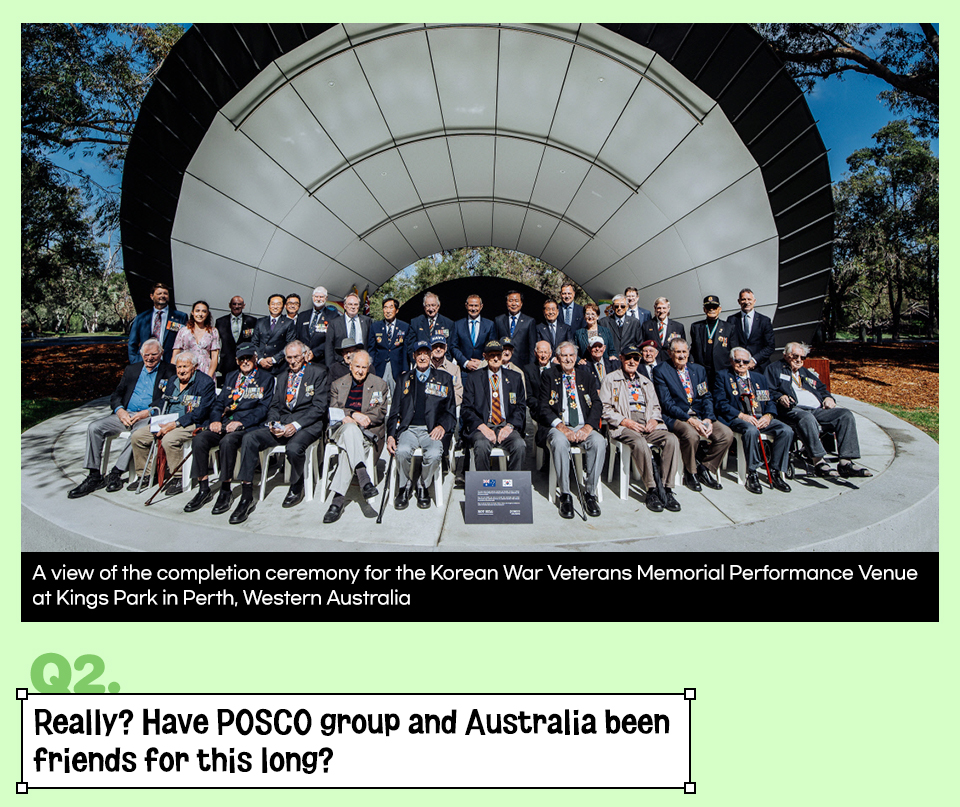
The partnership with POSCO stands as a symbol of bilateral cooperation between the two nations in mining materials and steelmaking. Beyond mining contracts, POSCO group also helped to build the Korean War Memorial in Kings Park, in Perth, Western Australia, to honor the sacrifice of Australian veterans who fought in the Korean War.
Today, Australia is responsible for supplying 70% of POSCO group’s production feedstock and a strategic partner in paving the way forward in future growth industries.
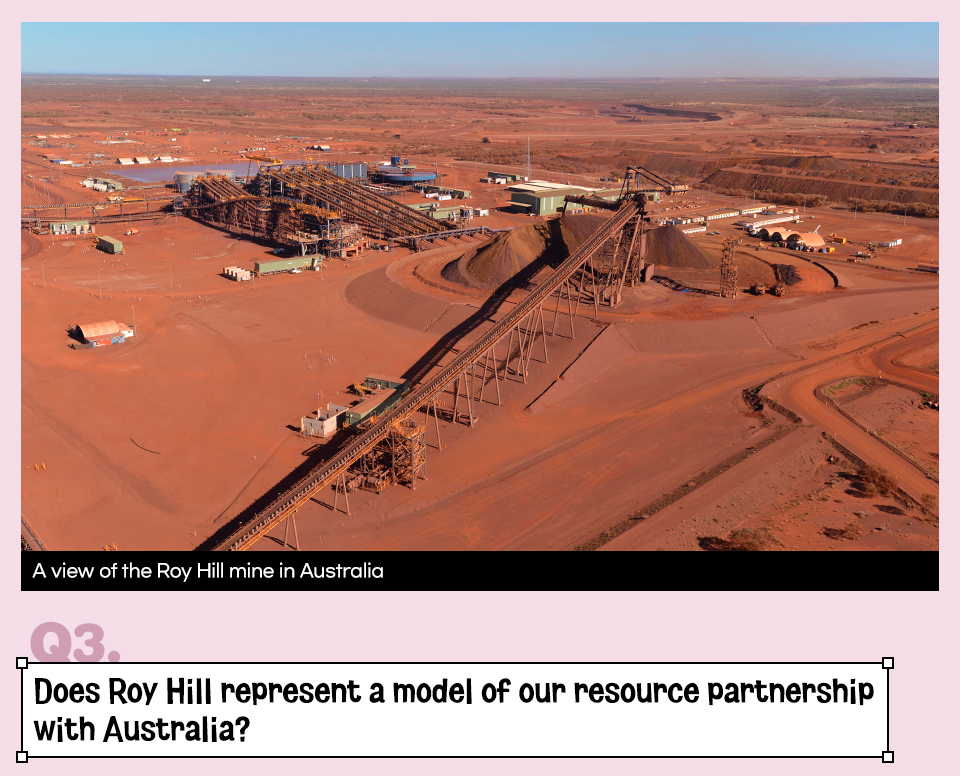
The development of the Roy Hill iron ore mine is indeed POSCO group’s flagship resource cooperation project in Australia.
Located in the Pilbara region of Western Australia, Roy Hill is Australia’s largest single-pit mine, boasting an annual production capacity of 64 million tons.
In 2010, POSCO group acquired a 12.5% stake in the project to take part from the early stages of development, securing both reliable offtake and high dividend returns.
The project is touted as a model of investment success. Today, POSCO has more than recovered its initial investment; the project continues to pay approximately KRW 300 billion in annual dividends.
Currently, Roy Hill is responsible for satisfying more than 20% of POSCO group’s annual iron ore demand.
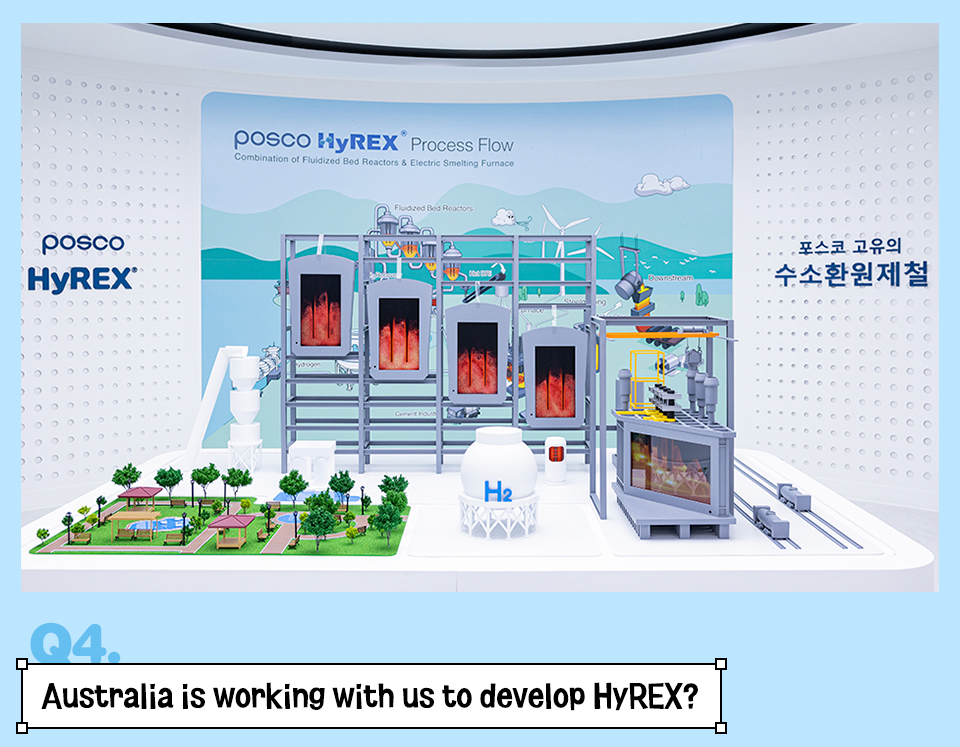
That’s correct! HyREX, or hydrogen reduction ironmaking, is a next-generation steelmaking technology that drastically reduces carbon emissions by replacing coal with hydrogen.
POSCO group is currently constructing a HyREX demo plant to test its proprietary process. Even BHP, Australia’s largest mining company and global raw materials leader, has come on board by signing an MOU; under this arrangement, we will share technical knowhow pertaining to the iron ore required to operate the demo plant.
Furthermore, POSCO group plans to produce carbon-reduced steel products through HyREX by capitalizing on Australia’s abundant renewable energy resources. Additionally, by converging the knowledge and expertise of both a global steelmaker and a materials provider, this project aims to model exemplary climate change response.
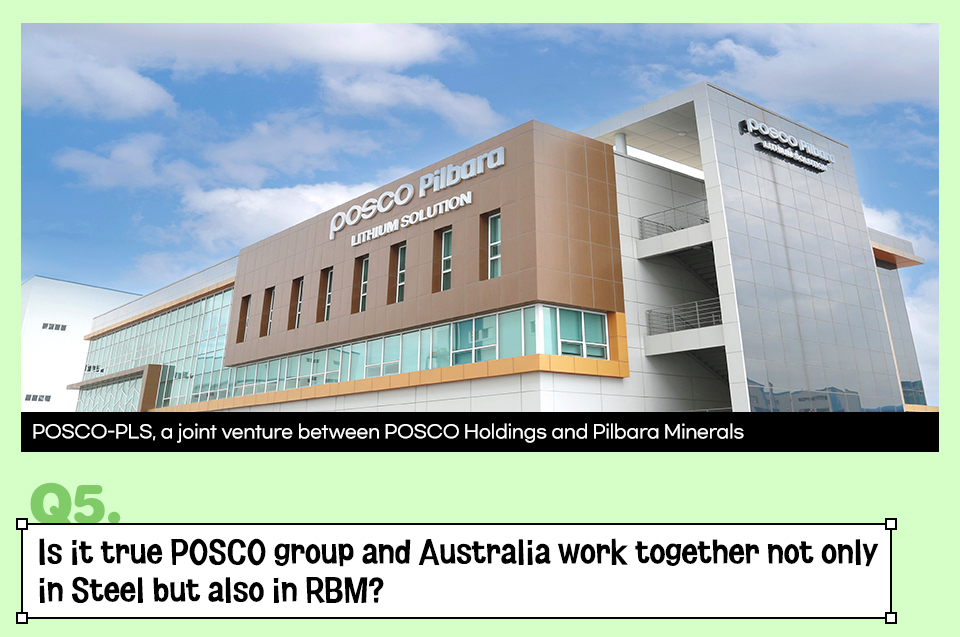
Absolutely! POSCO group is collaborating closely with Australia in key resources for future industries, including lithium—a core material for rechargeable batteries—as well as nickel and rare earths.
Since 2024, POSCO-Pilbara Lithium Solution (PPLS) in Gwangyang, South Jeolla Province, has been producing lithium hydroxide using spodumene, a lithium-bearing mineral mined in Australia.
In 2025, to identify future growth capabilities in industrial materials, POSCO group committed to invest KRW 1.1 trillion to acquire quality lithium resources in Australia and Argentina.
The long-standing cooperation, previously centered on fossil fuels, is now expanding into the field of rechargeable battery materials.
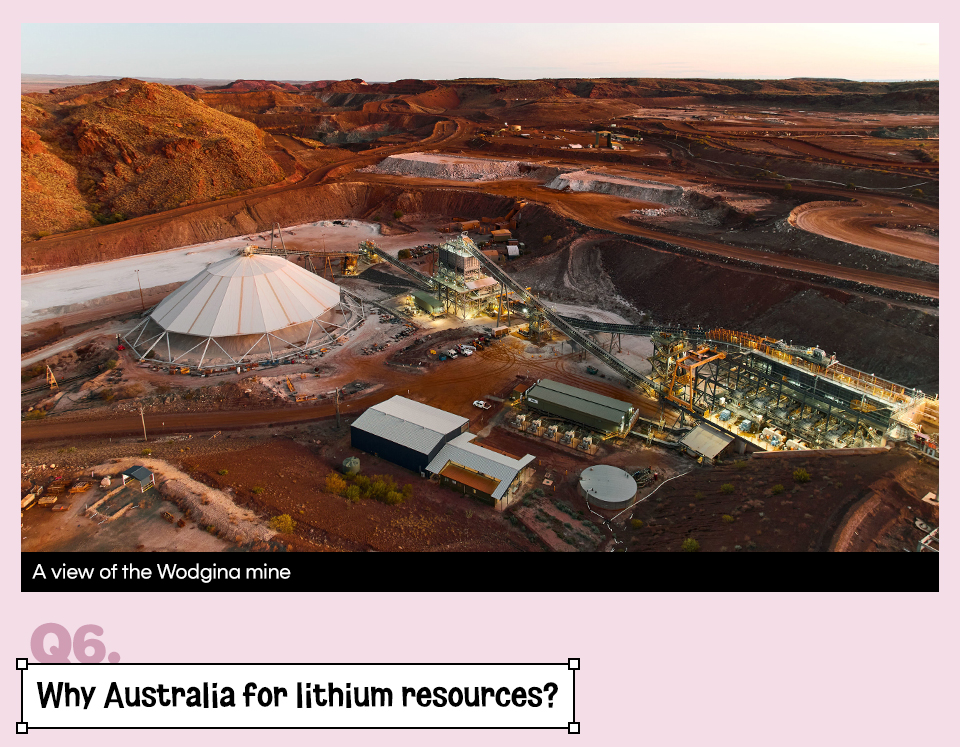
The answer to this question is quality. There are only about ten Tier-1 lithium mines worldwide; most are located in Western Australia.
In particular, the Wodgina and Mt. Marion mines are premium assets capable of extracting quality lithium.
It is in these mines that POSCO HOLDINGS has purchased stakes. Currently, Mineral Resources (MinRes), an Australian mining company, holds a 50% stake in each of the two mines. An intermediate holding company will be set up, jointly owned by POSCO HOLDINGS and MinRes. Under this arrangement, POSCO will invest $765 million (approx. KRW 1 trillion) to acquire a 30% stake in the intermediate holding company.
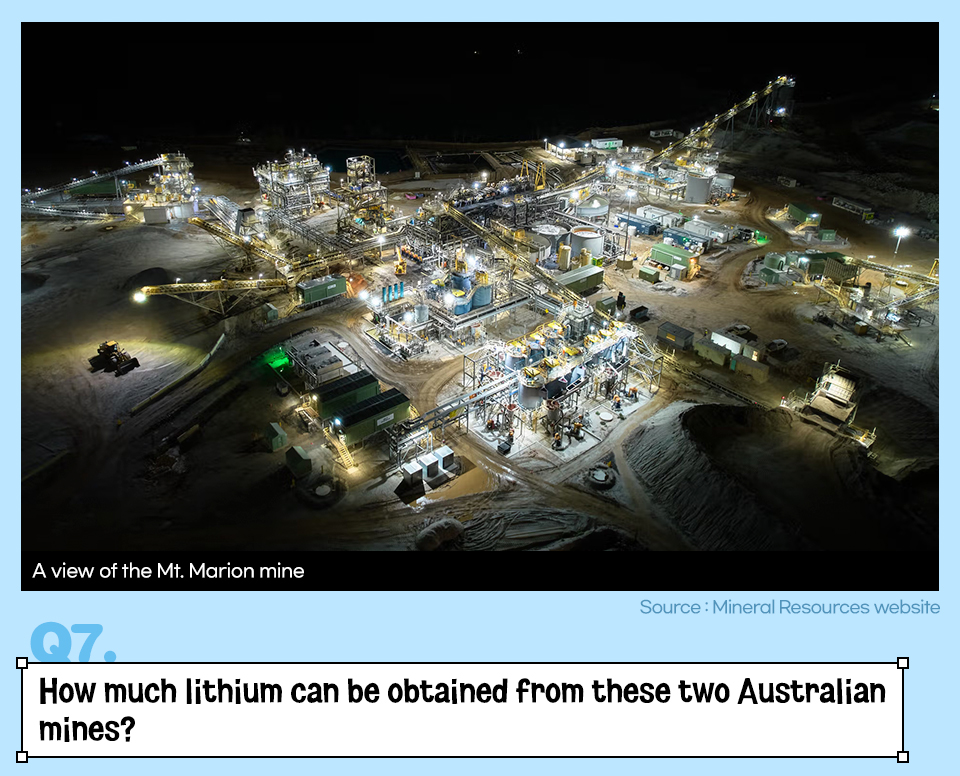
The Wodgina mine is estimated to hold approximately 6.5 million tons of LCE*, and Mt. Marion, 2.1 million tons of LCE.
POSCO group expects an annual supply of 270,000 tons of hard-rock lithium from these two mines. This volume equates to 37,000 tons of lithium hydroxide which is enough to power about 860,000 electric vehicles. Raw material cost accounts for a sizeable portion of production using hard-rock lithium.
Therefore, the more integrated the mine is to the production process, the more efficient the cost profile of lithium production. Consequently, this investment is a strategic decision made to mitigate the impact of price fluctuation while simultaneously enhancing the efficiency of the production process.
*LCE (Lithium Carbonate Equivalent): unit of measurement that converts lithium content into lithium carbonate volume
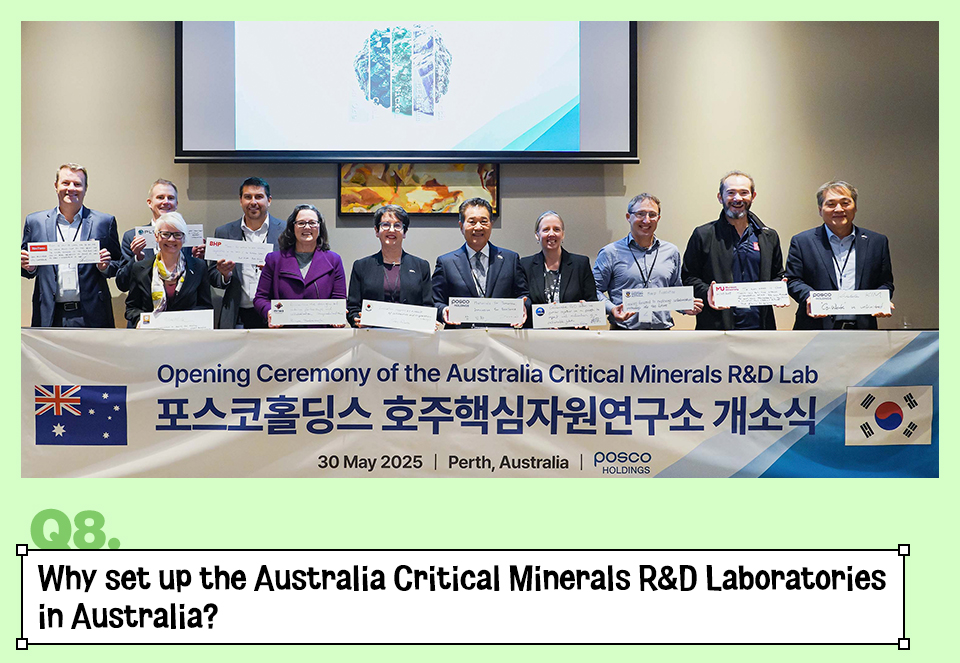
In May 2025, POSCO HOLDINGS established Australia Critical Minerals R&D Laboratories (CM Lab) in Perth, Western Australia. We were the first private Korean business to bring a collaborative global research lab to where the mines are located. The aim of the lab is to put distance between us and the competition in technology developed to advance steel, rechargeable battery materials, and rare earths.
The CM Lab serves as a strategic “hub” for raw material processing technology and critical minerals procurement. Together, we seek to add value across key operations by combining forces between Australia’s abundant natural resources and our advanced materials engineering capability.
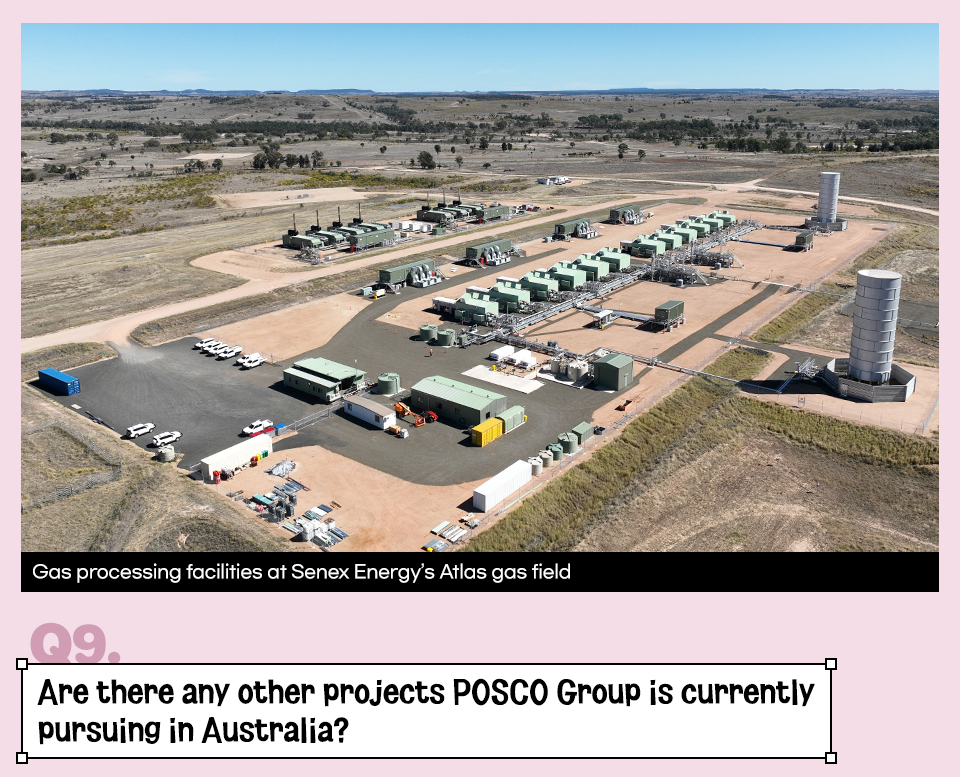
POSCO group is also collaborating closely with Australia to establish a clean energy ecosystem. In 2022, POSCO INTERNATIONAL partnered with Australia’s Hancock Energy to jointly acquire Senex Energy, a natural gas development and production company.
Since the acquisition, Senex Energy has increased its annual output from 20 PJ to 36 PJ in 2025, and it is moving forward with a phased expansion to reach 60 PJ (equivalent to 1.2 million tons of LNG). Once the expansion is complete, the company will meet approximately 10% of the natural gas demand in Eastern Australia.
Furthermore, POSCO HOLDINGS and POSCO E&C are exploring opportunities to collaborate with innovative Australian hydrogen producers. Through these efforts, we are broadening the spectrum of our partnership to future energy with Australia.
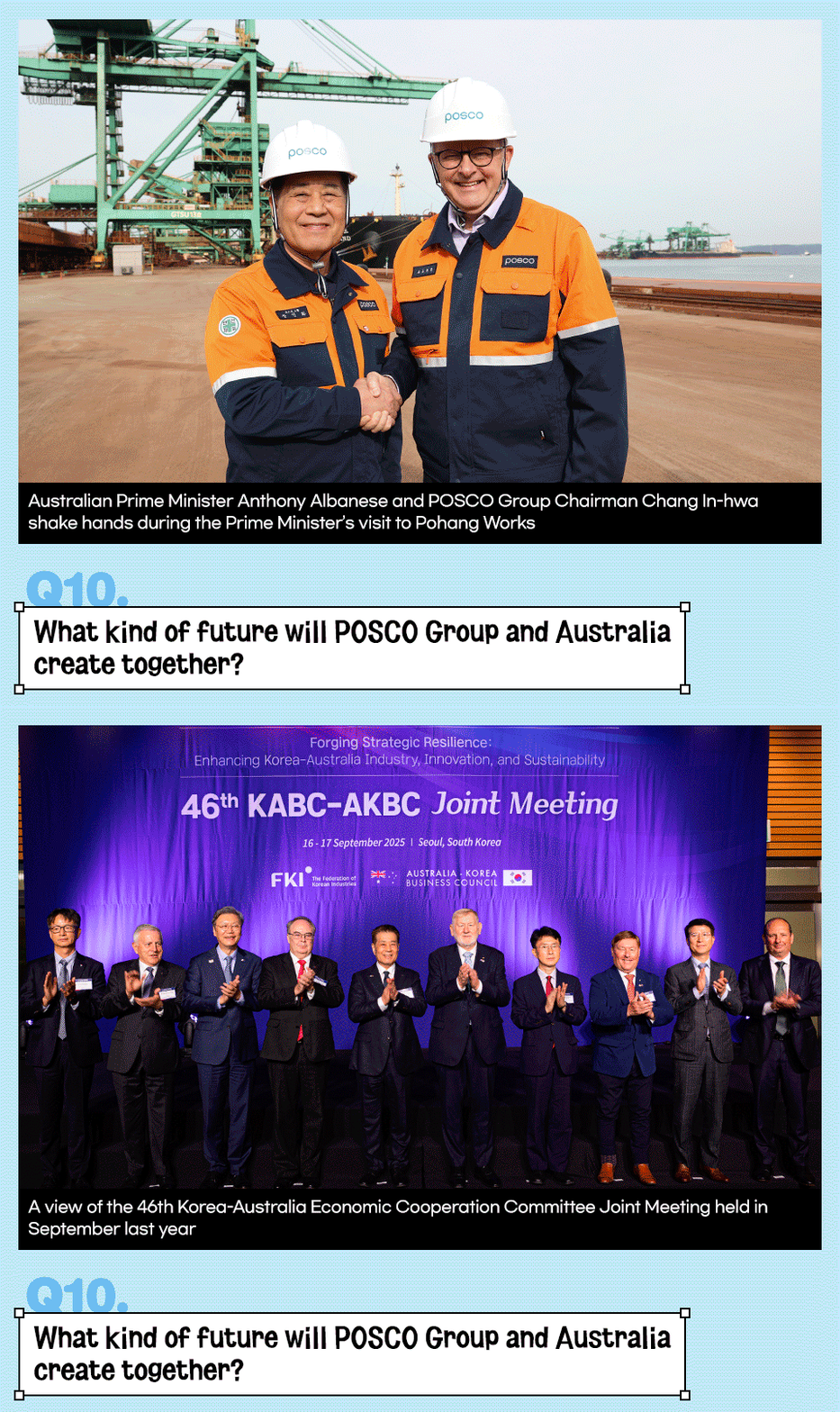
The strategic partnership between POSCO group and Australia has endured for more than half a century. Through comprehensive cooperation across steel, rechargeable battery materials and energy, both parties plan to establish a stable global supply chain and contribute to the advancement of future society.
Last year, Dr. Chang, In Hwa, CEO of POSCO HOLDINGS chaired the 46th joint meeting of the Korea-Australia Business Council (KABC). At the session, he discussed strategies to stabilize resource supply and expand collaboration in renewable energy.
Furthermore, POSCO group is broadening its network with major Australian research institutions, i.e., the Commonwealth Scientific and Industrial Research Organisation (CSIRO). This bilateral research collaboration is expected to enhance technological competitiveness in critical minerals.
Going forward, POSCO group will continue to fortify its technological position alongside its strategic partner, Australia.
we look forward to hearing more about the sustainable growth achieved
together by both Korea and Australia. Thank you.