With former U.S. President Donald Trump openly voicing his ambitions, Greenland — often dubbed “The Ice Kingdom” — has moved to center stage in global geopolitics. Recently, Trump signaled a shift from outright acquisition toward negotiations and expanded access rights. In the era of great-power rivalry, Greenland’s strategic value in terms of resources, security, and logistics is drawing unprecedented attention.
Senior Researcher Je-ho Cheong POSCO Research Institute
U.S. President Donald Trump : “I’d Like to Buy Greenland”
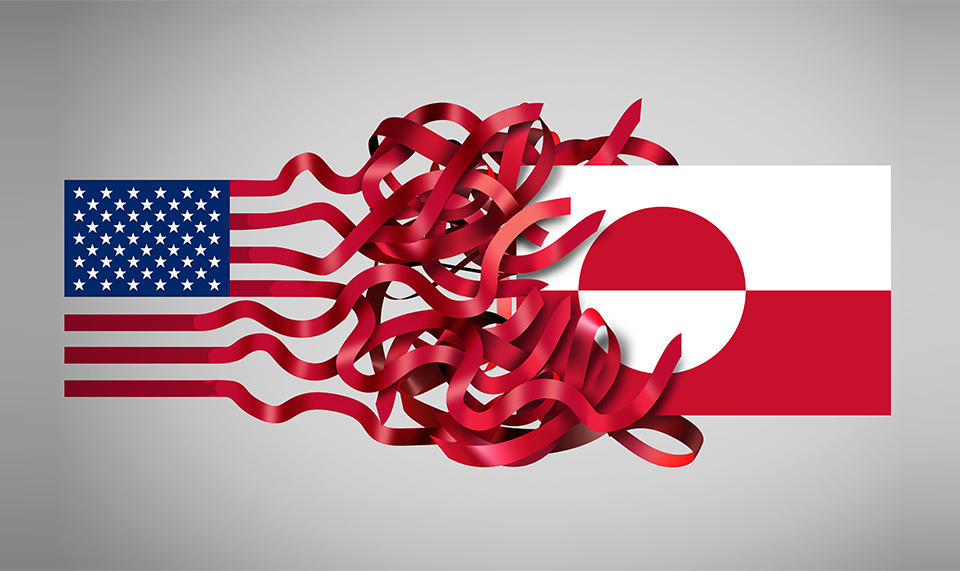
America’s interest in Greenland is nothing new. In 1867, U.S. Secretary of State William Seward — who orchestrated the purchase of Alaska — first explored the idea. In 1946, President Harry Truman offered Denmark $100 million in gold to buy the island.
In August 2019, when Trump declared, “I’d like to buy Greenland,” Denmark’s Prime Minister dismissed the idea as “absurd.” Later, the Trump administration floated military options and proposed tangible economic incentives to Greenlanders, fueling speculation that his ambitions might actually take shape.
Greenland’s Strategic Value in Security, Resources, and Supply Chains
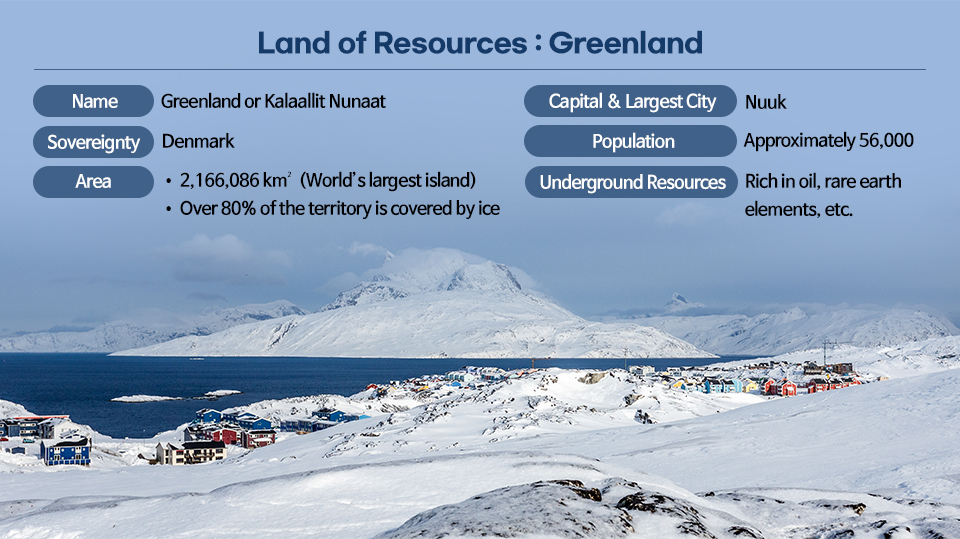
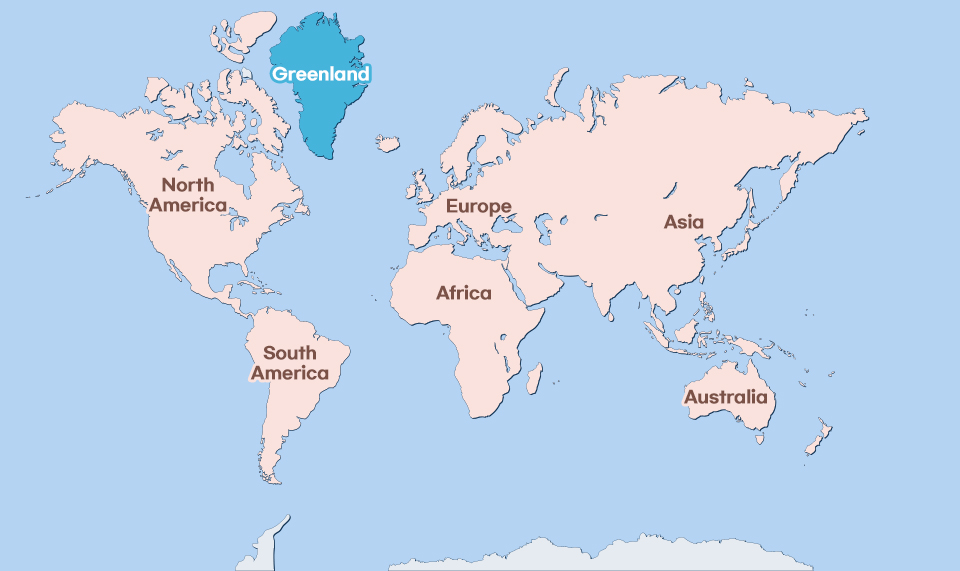
Greenland is the world’s largest island, situated between North America and Europe, touching both the North Atlantic and Arctic Oceans. Covering about 2,166,000 km² — roughly ten times the size of the Korean Peninsula — it has a population of just 56,000. A Danish territory since the 18th century, Greenland declared self-rule on June 21, 2009. While Denmark retains control over defense and foreign affairs, Greenland governs its own resources, judiciary, police, and legislation.
Over 80% of Greenland is covered by ice sheets, but rapid melting due to climate change is unlocking access to untapped resources. The opening of Arctic shipping lanes has further elevated its military, security, and supply chain importance.
A Security Linchpin for U.S. Defense
Greenland serves as an “unsinkable aircraft carrier” aimed at Russia, making it a cornerstone of U.S. defense strategy. The Pituffik Space Base in northwestern Greenland is the U.S. military’s northernmost installation, equipped with early-warning radar to detect ICBM launches. Geographically, it is about 4,400 km from Moscow — roughly half the distance from U.S. mainland bases — enabling faster strike capabilities in a crisis.
Greenland also sits within the GIUK gap (Greenland–Iceland–United Kingdom), a critical maritime choke point since the Cold War that blocks Russian submarines from entering the Atlantic. Full U.S. control over Greenland would significantly strengthen its ability to contain Russian naval forces.
A Resource Powerhouse: Rare Earths to Oil
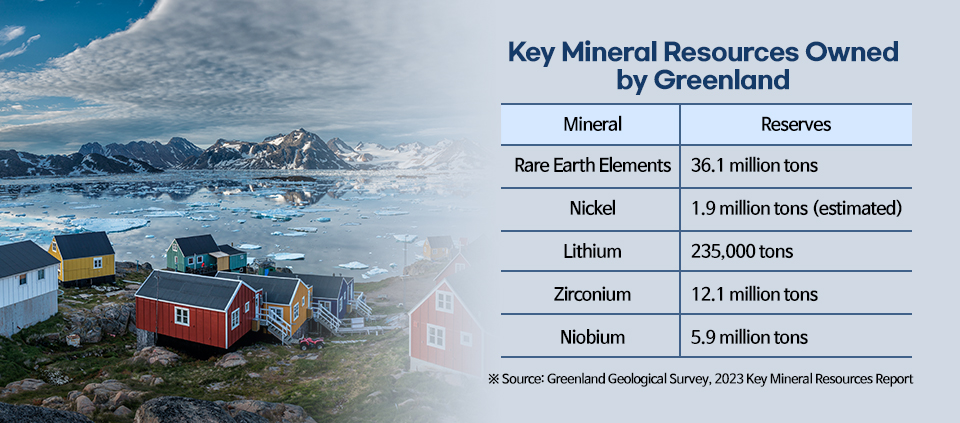
Greenland is rich in rare earth elements. The KvaneFjeld mine in the south is among the world’s largest deposits, estimated at over 10 million tons — enough to meet global demand for decades. It also contains uranium, lithium, nickel, cobalt, and other critical minerals for electric vehicle batteries. Rare earths essential for EV motors, wind turbines, and missile guidance systems — such as neodymium, praseodymium, and dysprosium — are abundant, making Greenland a prime alternative to China’s dominance in the rare earth supply chain.
The island is also believed to hold vast oil and natural gas reserves. The U.S. Geological Survey estimates the Arctic contains 13% of the world’s undiscovered oil (about 90 billion barrels) and 30% of its undiscovered natural gas. Greenland’s oil reserves alone are estimated at 31 billion barrels — comparable to U.S. shale oil reserves — with significant natural gas deposits offshore.
Gateway to the Arctic Route: A Future Logistics Hub
From a supply chain perspective, Greenland is a strategic prize. In 2018, China released its Arctic Policy White Paper, calling itself a “Near-Arctic State.” In response, the Trump administration made clear its interest in incorporating Greenland. China has since sought to invest in Greenland’s airport expansion and mining projects as part of its “Polar Silk Road” initiative, but the U.S. has pushed back hard.
For example, when Greenland’s autonomous government planned to expand three airports in 2018, China Communications Construction Company (CCCC) submitted a bid. Denmark welcomed the move, but then-U.S. Defense Secretary James Mattis objected, saying, “We cannot allow the Chinese Communist Party to build an air base in our backyard.” Under U.S. pressure, China was excluded, and the project was funded by Denmark and the U.S.
The U.S. attempt to purchase Greenland can be viewed as an Arctic‑era extension of the Monroe Doctrine*, aimed at preventing China’s growing influence in the region.
*Monroe Doctrine: A foreign policy declared by President James Monroe in his December 1823 State of the Union address. It emphasized non‑alignment, non‑colonialism, and non‑intervention, and opposed any external power’s attempts to interfere in or colonize the Americas.
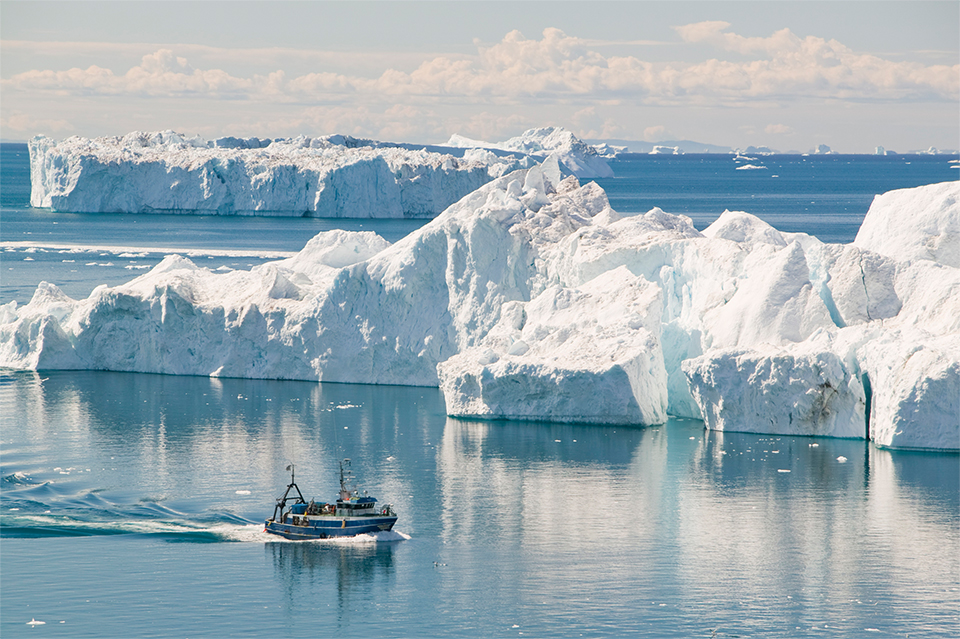
Melting ice is opening the Northern Sea Route, which can cut shipping distances by 30–40% compared to the Suez Canal. The Shanghai–Rotterdam route, for instance, is about 20,000 km via the Suez Canal but only 14,000 km via the Arctic. If the Arctic route becomes fully operational, Greenland could emerge as a mega logistics hub — akin to historical Venice or modern-day Singapore.
Currently, the route runs along Russia’s coast. If the U.S. uses Greenland as a base to control the western gateway, it could secure an alternative path and counter Russian influence.
Could Greenland Become Part of the US?
In a January 8 interview with The New York Times, Trump said, “Ownership is very important. There are things you can’t get through leases or treaties that you can get through ownership.” When asked whether Greenland’s acquisition or NATO’s maintenance was more important, he hinted that Greenland could take priority.
For Washington, Greenland is a critical asset in countering China and Russia — militarily, economically, and logistically. Trump’s remark that “my morality comes before international law” underscored his willingness to disrupt the existing order to secure it.
While the U.S. already operates bases in Greenland under agreements with Denmark, it prefers permanent ownership over leases that could be revoked with a change in government. Greenlanders, however, insist: “We are neither Danish nor American — we are Greenlandic. We are not for sale.” They want independence from Denmark but have no desire to become America’s 51st state.
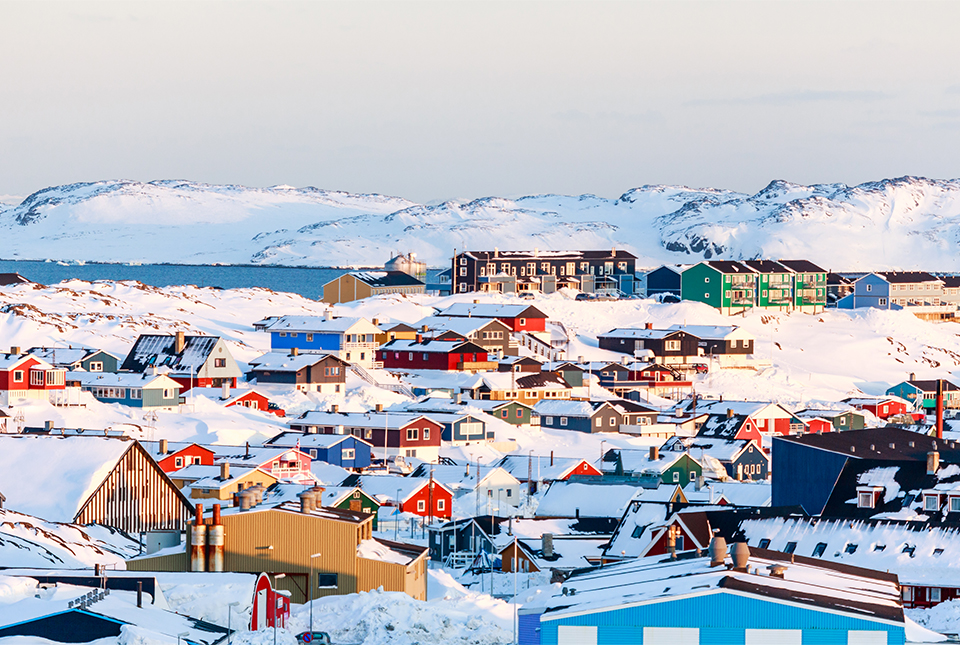
Under Greenland’s 2009 Self-Government Act, its people have the right to decide on independence. While polls show strong support for independence, the island’s heavy reliance on Danish subsidies — over 50% of its budget — makes the prospect risky. Support drops sharply when potential declines in living standards are factored in.
Recently, Trump claimed, “Negotiations have begun, and we are close to an agreement.” Analysts believe he may be shifting from outright ownership to securing broad access rights.
Experts predict that, regardless of sovereignty, the U.S. will likely expand its military and economic footprint in Greenland. If ownership proves unattainable, Washington may seek to broaden military rights through agreements with Denmark and strengthen economic influence via resource deals with Greenland’s autonomous government. Still, climate change and shifting geopolitics could quickly alter Greenland’s fate.