
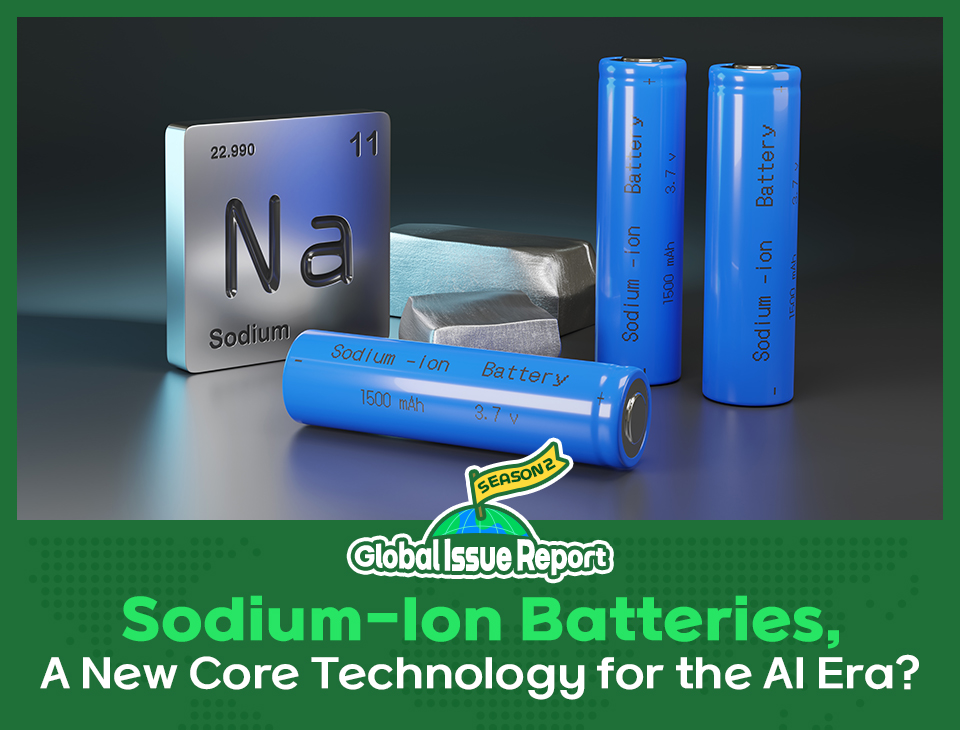
As AI adoption accelerates, power demand from data centers is surging, making energy storage systems (ESS) increasingly important for stable power storage and supply. Against this backdrop, sodium-ion batteries are drawing attention as a new alternative thanks to their cost competitiveness and safety. This article looks at whether sodium-ion batteries can emerge as a new strategic technology in the AI era.
RA, CHO Young Ki, POSCO Research Institute
Is Salt the New Oil? Sodium-Ion Batteries Gain Attention in the AI Era
If securing oil determined competitiveness in the age of industrialization, then in the AI era, a company’s ability to store electricity efficiently and reliably is becoming a new source of competitive advantage. As the construction of AI data centers rapidly expands, ESS (Energy Storage Systems) capable of storing and supplying massive amounts of electricity in a stable manner are becoming more important than ever.
Amid these changes, sodium-ion batteries are emerging as a key technology for power infrastructure in the AI era. Global investment bank Morgan Stanley has described sodium-ion batteries as a core technology for the “New Oil Age” that will shape future industries.
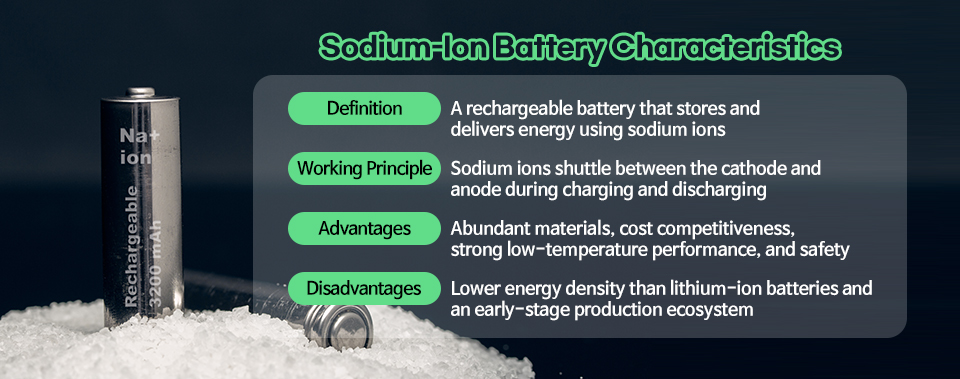
Sodium-ion batteries use sodium ions instead of lithium as the charge carrier* and offer strengths such as stable performance even in low-temperature environments and a high level of safety. In particular, sodium, one of their key raw materials, is abundant in seawater and the Earth’s crust, making it highly accessible as a resource. As a result, sodium-ion batteries are gaining attention as an alternative that could reduce dependence on the key raw materials used in conventional lithium-ion batteries while also helping address raw material price volatility and supply chain risks.
* Charge carrier: An ion that moves between the cathode and anode during the battery’s charge and discharge process to transfer electric charge. In sodium-ion batteries, sodium ions (Na⁺) play this role.
Growing Demand for Sodium-Ion Batteries, Led by ESS and Commercial Vehicles
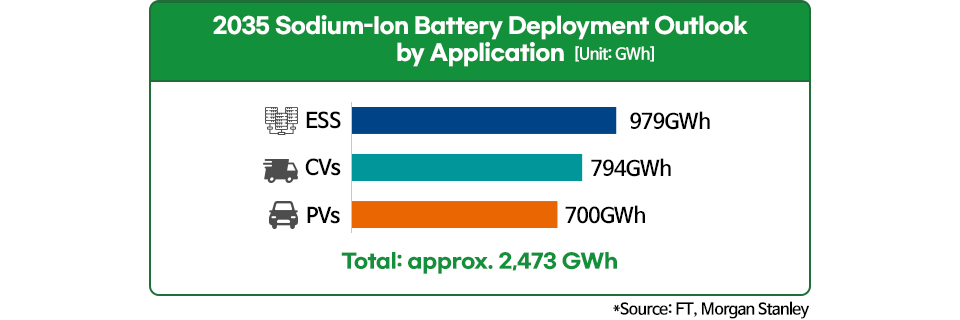
As sodium-ion batteries gain traction as a key component of power infrastructure in the AI era, the related market is also expected to grow rapidly. Morgan Stanley projects that annual sodium-ion battery deployment could reach approximately 2,473 GWh by 2035. If market expansion accelerates more quickly than expected, deployment could rise to as much as 3,726 GWh.
In that scenario, cumulative investment, including ESS installations, manufacturing facilities, material supply chains, and grid infrastructure, is estimated to total around USD 800 billion. By application, ESS is expected to account for the largest share at 979 GWh, followed by commercial vehicles at 794 GWh and passenger vehicles at 700 GWh.
Potential Applications of Sodium-Ion Batteries in Data Center ESS
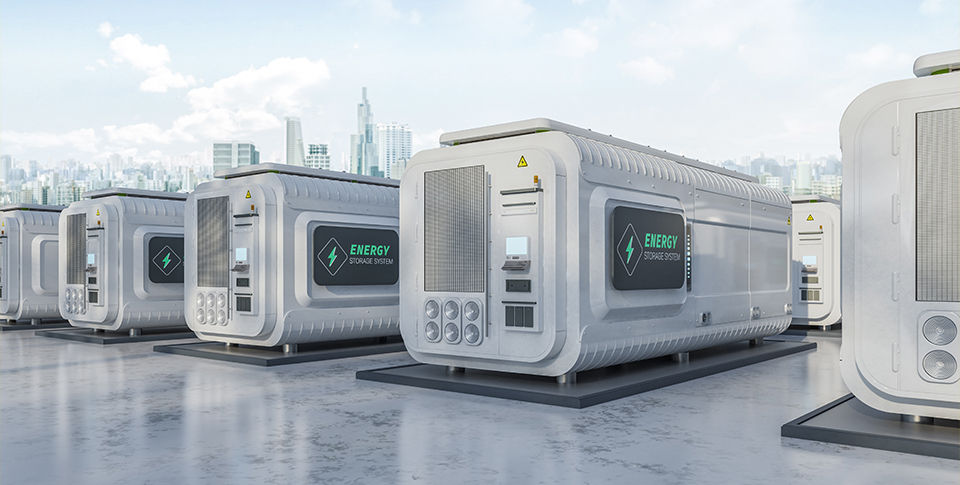
Unlike electric vehicles, ESS faces relatively fewer constraints related to battery weight and volume. Instead, key decision-making criteria include upfront installation costs, safety, lifespan, low-temperature performance, and long-term operating costs. Under these conditions, sodium-ion batteries are being evaluated as a promising option for data center ESS.
In particular, batteries for data centers must do more than provide emergency backup power during outages. They also need to absorb sudden power fluctuations generated by AI server systems and help manage peak power demand so that overall electricity use does not exceed grid supply limits.
Sodium-ion batteries offer several advantages in this context. They are considered to carry a relatively lower fire risk and can maintain comparatively stable performance even in low-temperature environments. In addition, the copper foil used as the anode current collector in lithium-ion batteries can be replaced with aluminum foil in sodium-ion batteries, lowering material costs. This makes them an attractive option for improving both safety and operational efficiency in data centers.
Beyond data center ESS, Morgan Stanley also analyzed the Chinese light commercial vehicle market as a case in point, suggesting that sodium-ion batteries could be applied to light-duty commercial vehicles used for logistics and delivery. In particular, in colder regions where winter driving stability is critical, the low-temperature performance of sodium-ion batteries could become a key differentiator.
* LCV (Light Commercial Vehicle): Commercial vehicles for logistics, such as small trucks and vans
Are Cheap Raw Materials Enough? Entry Barriers in the Sodium-Ion Battery Market

Some expect entry barriers to be low in the sodium-ion battery market because sodium reserves are abundant. However, sodium-ion batteries have lower energy density than LFP batteries, and dedicated material supply chains as well as large-scale mass production experience have yet to be fully established. As a result, their actual cost competitiveness and performance stability still require further validation.
Moreover, to be supplied for ESS and vehicle battery applications, sodium-ion batteries must comprehensively prove their fire safety, lifespan, charge-discharge performance, quality assurance, and long-term supply capability. This suggests that major battery manufacturers with accumulated R&D expertise and mass production experience are likely to take the lead.
By contrast, some small and mid-sized LFP battery makers with limited technological differentiation could face greater pressure as sodium-ion batteries spread. Morgan Stanley noted that if sodium-ion batteries gain wider adoption, the bottom 30–40% of China’s LFP production capacity—where technological differentiation is relatively weak—could come under greater pressure.
Can Salt Replace Lithium? What Is the Real Battery Edge the AI Era Demands?
While sodium-ion batteries offer strong market potential based on a range of advantages, many believe they are unlikely to completely replace LFP batteries in the short term. According to Morgan Stanley, sodium-ion batteries are more likely to be adopted first in markets where cost, safety, and low-temperature performance matter most, such as ESS and commercial vehicles. On the other hand, in ESS projects already built around LFP or where long-term operational track records are critical, LFP batteries—with their price competitiveness and mass production experience—are expected to maintain their leading position for the time being.
In addition, if lithium prices decline in the future, LFP battery prices could also fall, weakening the cost advantage of sodium-ion batteries more than expected. In this sense, the phrase “salt is the new oil” does not necessarily mean that sodium will fully replace lithium. Rather, it suggests that in the AI era, the ability to store electricity cheaply and reliably is becoming a defining factor in industrial competitiveness. Ultimately, in the battery market ahead, the technologies and companies that can secure competitiveness across cost, safety, lifespan, and supply stability are likely to take the lead.
| ✓ | As AI data centers and ESS continue to expand, sodium-ion batteries are gaining attention as a low-cost and reliable power storage technology. |
| ✓ | Backed by abundant reserves, cost competitiveness, and strong low-temperature performance, they are emerging as a new alternative for the ESS and commercial vehicle markets. |
| ✓ | Rather than replacing LFP batteries in the short term, sodium-ion batteries are expected to become a key option in power storage for the AI era and help strengthen industrial competitiveness. |